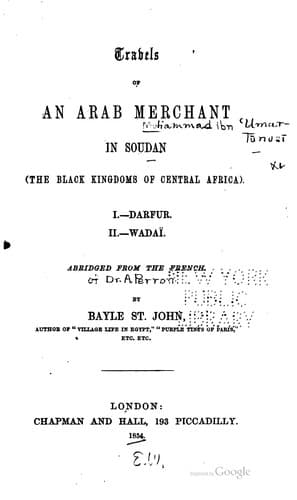
Travels of an Arab merchant in Soudan (the Black Kingdoms of Central Africa)Tūnisī, Muḥammad ibn ʻUmar
History
Travels of an Arab merchant in Soudan (the Black Kingdoms of Central Africa)
Tūnisī, Muḥammad ibn ʻUmar
Darfur (Sudan) -- Description and travel; Wadai (Sultanate) -- Description and travel
[Footnote 27: Those who are acquainted with the history of recent
political events, need not go to the centre of Africa for an example
of a prince pausing in the midst of massacre to perform those pious
duties which public opinion is always ready to set down to the account
of the powerful.]
[Footnote 28: I cannot again refrain from pointing out the singular
similarity which exists between the histories of all nations in which
the idea of authority is developed, and in which a man or a family
presumes to look upon a whole people as personal property. The fact of
this similarity is, perhaps, the only useful information we can derive
from a study of the bloody annals of empires, present or past,
expiring or nascent.]
[Footnote 29: It is amusing to see the right divine of kings asserted
in the person of the ferocious Saboun, and how priests of all forms of
faith are ready to justify bloodshed in the interest of authority. It
must be observed, that the learned men to whom this case was submitted
made no allusion to the mild alternative expressed in the last words
of the law.]
[Footnote 30: This splendid description of how an African prince wades
through slaughter to a throne, and at once becomes an idol, is an
unconscious satire of some of the great events of modern history.]
[Footnote 31: I have preserved with some regret the constant reference
to a sacred Name in this Chapter, because the frightful picture it
contains, and the terrible code of political morals which it
represents, would be otherwise incomplete. The Sheikh, who has no
suspicion of wrong, goes on to give his theory of absolute government,
and, naturally taking the optimist view, uses the old comparison of
the shepherd and the flock. I may remark that it is peculiarly
characteristic of the bloodiest despotic governments, and their
defenders of all degrees of refinement, to make a wanton use of the
Divine Name.]
[Footnote 32: M. Fresnel, French consul at Jeddah, has published a
memoir on the abou-kern, which he considers to be the unicorn, and not
the rhinoceros.—_Perron_. In this case, however, the Sheikh clearly
marks that he means the khartit; and in no part of his work makes
allusion to the unicorn.]
[Footnote 33: This title corresponds to the Ab of Wadaï and Darfur.]
[Footnote 34: The Sheikh here enters into considerable details on the
revolution by which this change of government took place. Those who
have read the “Journal” of Mr. Richardson will be aware that his
principal servant was a descendant of the Moknee mentioned in the
text.]
Public-domain text, read in full here on John Shaqi.
Reviews
Reviews
No reviews yet
Be the first to share your thoughts on this work.
Elsewhere in the archive
Join the Discussion
Join the discussion
Sign in to leave a comment or review.
Sign InorCreate an account