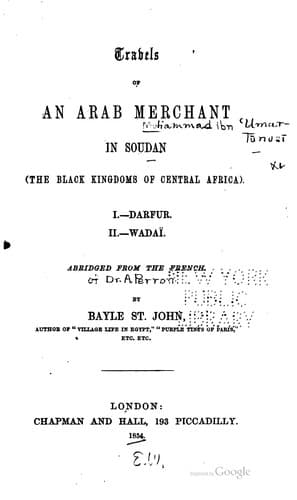
Travels of an Arab merchant in Soudan (the Black Kingdoms of Central Africa)Tūnisī, Muḥammad ibn ʻUmar
History
Travels of an Arab merchant in Soudan (the Black Kingdoms of Central Africa)
Tūnisī, Muḥammad ibn ʻUmar
Darfur (Sudan) -- Description and travel; Wadai (Sultanate) -- Description and travel
Then they stripped him, and found that he had more than a hundred
wounds from sabre or lance. Meanwhile the son of his wife—he
was himself an eunuch[8]—named Shilfoot, came, breaking through
the crowd, in the hopes of finding him still alive, and rescuing
him—but it was too late; so he fell right and left upon the enemy,
killing numbers of them, and shouting, “Come, the price! the
price! Pay me the price of Kourra!” At length, however, he
also fell.
Such was the end of the great Ab Sheikh, Mohammed Kourra; and
I will now relate his life, and how he raised himself to power;
and I will set down, at the same time, what I have learned from
several old men about the history of the Sultans of Darfur.
The Sultan Mohammed Fadhl was son of the Sultan Abd-er-Rahman,
who was son of the Sultan Ahmed Bekr. The latter had seven sons,
Omar, Abûl Kasim, Riz, Rifa, Tyrab, Tahir, and Abd-er-Rahman,
surnamed El-Yatim, or The Orphan—because, at the death of his
father, he was still unborn. When Ahmed Bekr saw that his hour was
drawing nigh, he assembled around him the dignitaries of the state,
and declared it to be his last will that the Sultanship should pass
alternately from one of his sons to another, as death took them off;
but that the children of each should not reign until all the seven
were dead. So Omar governed in the first place, and reigned until
he fell in battle against the sovereign of Wadaï. His successor,
Abûl Kasim, also reigned seven years, and was killed in the same
way. To him succeeded Tyrab, surnamed the Seeds of Syria, who hated
war, and remained at home, occupied in the cares of government
for thirty-three years. He loved boisterous amusements, and was
fond of dress. During his reign there was fertility and peace,
and all provisions were cheap. But, towards the end of his life,
he was detested on account of the extravagant conduct of his
children, who were in number more than thirty, without counting
the girls. These princes were ever wandering on horseback through
Darfur; and if they heard of any valuable thing at once seized it
as their property. Every one suffered by them and feared them. One
went so far as to give up riding on horseback, and would only ride
upon men, seizing any passers-by, and compelling them to carry
him. Complaints were made to the prince, who would not, however,
believe or pay any attention to them. The eldest of his sons was
called Izhak, surnamed the Kaliph, and was brave, intelligent,
but avaricious and tyrannical.
Tyrab was addicted to debauch and to pleasure. Often young girls
and boys played and danced together in his presence, and he loved to
behold them. One day a troop of Birguids came to the Fasher. These
people have a particular dance, called Tendegueh, during which,
when the couples are tired, they go, lads and lasses, two by two,
to sit together; and so, after they had danced before the Sultan,
they went thus to sit two by two, and one of the dancers said to
his partner,—
Public-domain text, read in full here on John Shaqi.
Reviews
Reviews
No reviews yet
Be the first to share your thoughts on this work.
Join the Discussion
Join the discussion
Sign in to leave a comment or review.
Sign InorCreate an account