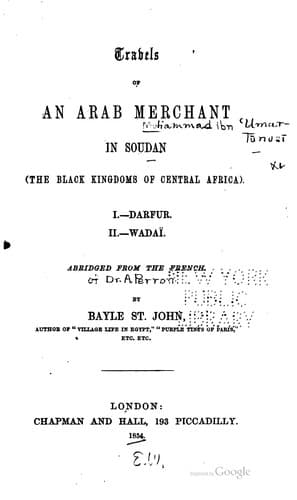
Travels of an Arab merchant in Soudan (the Black Kingdoms of Central Africa) — John Shaqi
Travels of an Arab merchant in Soudan (the Black Kingdoms of Central Africa)Tūnisī, Muḥammad ibn ʻUmar
History
Travels of an Arab merchant in Soudan (the Black Kingdoms of Central Africa)
Tūnisī, Muḥammad ibn ʻUmar
Darfur (Sudan) -- Description and travel; Wadai (Sultanate) -- Description and travel
“Wilt thou take me for thy husband?”
“Yes; but what wilt thou give me for a dowry?”
“Alas! I am poor; I can give thee nothing more valuable than he
who is opposite me.”
This was the Sultan.
“Very good,” said the girl: “I accept.”
Now it happened that Tyrab was observing their signs, and called them
to him, and asked for an explanation. The young man boldly said,—
“I was asking my sweetheart here, if she would marry me; she
consents, but asks for a dowry; and I have answered her that I have
none other to give but thee.”
“This is a singular dowry,” said Tyrab; “and has she
accepted?”
“Certainly,” said the young man.
Then the Sultan said to the girl,—
“Wilt thou allow me to take a substitute, and to pay a ransom?”
“Willingly,” answered she; “I consent—I accept.”
So Tyrab sent for the father of the young girl, and asked
her in marriage, and drew out the contract with her father;
and gave to the bride for dowry two beautiful slaves, and to the
bridegroom a handsome negro; and, moreover, added wherewith to live
comfortably. Verily, this was a fine trait, for there is nothing
more excellent than to unite those who love by a pure tie.
A similar story is told of the Kaliph, Abou-Bekr. He used to
wander by night through the Brilliant City, in order to know the
true state of his people, and to discover who was the victim of
oppression. In one of his rounds he heard in the street a young
girl singing these verses:—
“Alas, I loved him even before they tore away my talisman;
In his walk he describes the graceful bending of a branch:
His countenance is like the lustre of the full moon—
Like it, he appears and disappears,
And he is of the stock of Hashim.”
Abou-Bekr knocked at the door, and said to this young girl,—
“Who is he that thou lovest?”
“Depart from hence,” cried she.
He persisted, saying: “Thou must tell me the name of him thou
lovest.”
“By the name of the Prophet, who is now in his tomb, I conjure
thee to depart from hence!”
“By the name of God, I will not go away until thou hast told me
who is the object of thy love!”
Then she heaved a profound sigh, and replied,—
“An unhappy flame consumes me; I am full of trouble. I love
Mohammed, son of Kasim.”
“But art thou free?”
“No; I am a slave.”
“Of whom?”
“Of such a one,” naming him.
Then Abou-Bekr went away, and, in the morning, learned that the son
of Kasim was upon an expedition in Irak. So he bought the young
slave-girl, and sent her with a letter to her lover, explaining
what had come to pass; and adding, “My son, how many hearts have
sickened unto death for women! and how many virgins have languished
in disappointment!”
Public-domain text, read in full here on John Shaqi.
Reviews
Reviews
No reviews yet
Be the first to share your thoughts on this work.
Join the Discussion
Join the discussion
Sign in to leave a comment or review.
Sign InorCreate an account