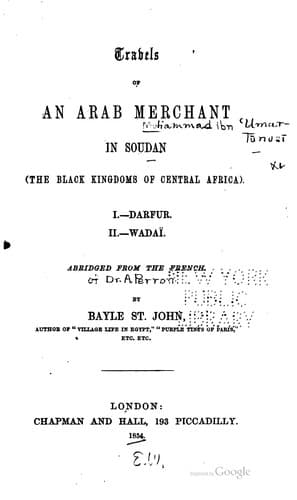
Travels of an Arab merchant in Soudan (the Black Kingdoms of Central Africa)Tūnisī, Muḥammad ibn ʻUmar
History
Travels of an Arab merchant in Soudan (the Black Kingdoms of Central Africa)
Tūnisī, Muḥammad ibn ʻUmar
Darfur (Sudan) -- Description and travel; Wadai (Sultanate) -- Description and travel
The youth of Abd-er-Rahman had been exemplary. He had learned the
Koran by heart, and had applied himself to the study of laws. He
had never imitated the bad habits common to the sons of the Sultans
of Darfur, who used to ride through the country and treat every
Forian as if he had been a slave. From his earliest age he had been
without reproach, and pure, and if he arrived, during his travels,
at any place, he used to say, “I am the host of God,” and if he
were well received, he remained, and, if not, he went his way. It
is related that, in one of his travels, he put up in the house
of a man belonging to the Berli tribe. This man recognised him,
and killed a fat sheep for his sake. Upon which the Orphan said,—
“My friend, might we not have been satisfied with less than
this? If thou hadst killed a fowl, it would have been sufficient.”
“No, my master, no! I swear by God, if I had possessed a she-camel,
I would have killed it for thee! Art thou not Abd-er-Rahman, the
son of our Sultan?”
“And how dost thou know me?”
“I know thee by thy virtues and thy piety, and I predict that
days of glory await thee.”
“Then I, too, swear by the name of God, that if ever I become king,
I will give thee wherewith to enjoy better cheer than this!”
He kept his promise, and when he became Sultan appointed his host to
be tax-gatherer over the Arab tribe called the Madmen. Many similar
stories are told of him, and the country was full of predictions
that it would be the Orphan who would succeed Tyrab. The latter
prince once tried to poison him, but failed. It was generally
reported that his love of science overcame all other passions. He
went about in an old ragged shirt, with a wooden chaplet in his
hand. He remained in celibacy until his beard began to whiten,
being, in fact, too poor to buy a slave or to marry. He never had
a companion until, on his way to Kordofal with his brother, the
Sultan, a king gave him as a present an ugly slave, named Anbousah,
by whom he had a son, the Sultan Mohammed Fadhl, who now reigns.
Abd-er-Rahman distinguished himself by vigour at the outset of his
reign, abolished the custom of seven days of laziness after the
inauguration, and prepared to depart for Darfur, and dispute the
possession of the country with Izhak. The two hostile armies met
and fought twice. During the second battle, it is said, at mid-day
the stars appeared in the sky. I have seen the battle-field; it
is perfectly arid, and I was told that no plant would grow there
on account of the quantity of blood that had been spilt. Izhak was
defeated on both occasions, and retired into the northern provinces,
where he reigned for some time with great cruelty, and gained some
advantages in the war that ensued. The struggle continued for
a long time, until the Kaliph was killed in a battle by Zabady,
an Egyptian fellah, who shot him from a distance. This ended the
war, and Abd-er-Rahman became sovereign of the whole country,
and established his Fasher at Tendelty.
Public-domain text, read in full here on John Shaqi.
Reviews
Reviews
No reviews yet
Be the first to share your thoughts on this work.
Join the Discussion
Join the discussion
Sign in to leave a comment or review.
Sign InorCreate an account