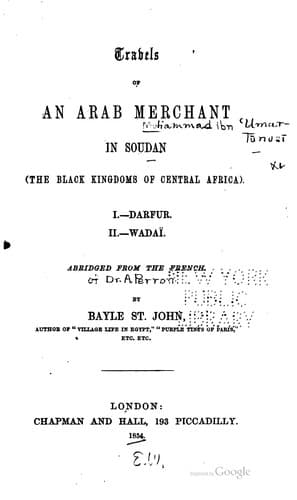
Travels of an Arab merchant in Soudan (the Black Kingdoms of Central Africa)Tūnisī, Muḥammad ibn ʻUmar
History
Travels of an Arab merchant in Soudan (the Black Kingdoms of Central Africa)
Tūnisī, Muḥammad ibn ʻUmar
Darfur (Sudan) -- Description and travel; Wadai (Sultanate) -- Description and travel
When the Orphan was free from the anxieties of war he applied himself
to administrative reforms, and did everything he could to increase
the prosperity of the country. He repressed the habit of drunkenness
and debauchery that had prevailed, and rendered the roads so secure
that a woman could travel there with all her ornaments. Commerce
increased, and comfort was spread through the country. Justice and
equity prevailed. He had no pity on those who committed an act of
violence or spoliation of any kind, however nearly related.
It has been related to me that he was once met, as he returned
from the chase, by two Arabs, one of whom addressed him in these
words:—“An injustice has been done me, O Rashid![9] may God
preserve thee, an injustice has been done me!” Now, it is the
custom among the Forians, that whoever has been a victim of violence
utters the cry called Karourak, which is never uttered on any other
occasion. The sound is produced by the help of two fingers inserted
into the mouth, and moved rapidly from side to side, whilst the
letter K is intonated, followed by a paralysed R. Well, one of our
Arabs was rolling the Karourak, and repeating “May God preserve the
Rashid, I am the victim of an injustice!” but the Sultan, at first,
paid no heed, either being occupied by some idea, or not hearing,
on account of the sound of the tambourines, and the songs and the
hurrahs of the soldiers. The Arab had Karouraked several times,
and the Sultan had not asked the reason. Then the other Arab said
to his companion, “Let him alone; Rashid is all for himself,
and cares nothing for thee.” The Sultan heard these words, and
asked what was meant. The man replied,—
“My friend here has Karouraked several times, and has complained
to thee. This was the origin of my remark.”
The Sultan smiled, and said,—
“Not so, I am not all for myself. Who has done thee injury?”
“Basy-Khabir.”[10]
Now, Basy-Khabir was one of the relations of the Orphan, who,
however, asked,—“What has he taken from thee?”
“He has taken five she-camels.”
The Sultan inquired into this charge, and having found it to be true,
condemned Khabir to give back ten camels instead of five.
Abd-er-Rahman nominated, as he had promised, Mohammed Kourra to the
post of Father-Sheikh, the highest dignity in Darfur. He who bears
it is invested with the right of life and death, and has a court and
insignia like the Sultan. No one but an eunuch can occupy this post,
because it is feared that whoever occupies it may be induced to
conspire to raise himself to the throne. When Kourra was confirmed
in his dignity of Ab, the Sultan sent him to the provinces, and he
established himself at Aboul-Joudoul.
Public-domain text, read in full here on John Shaqi.
Reviews
Reviews
No reviews yet
Be the first to share your thoughts on this work.
Join the Discussion
Join the discussion
Sign in to leave a comment or review.
Sign InorCreate an account