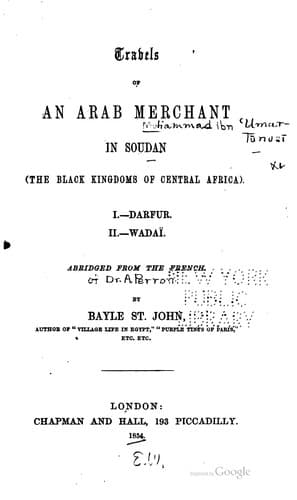
Travels of an Arab merchant in Soudan (the Black Kingdoms of Central Africa)Tūnisī, Muḥammad ibn ʻUmar
History
Travels of an Arab merchant in Soudan (the Black Kingdoms of Central Africa)
Tūnisī, Muḥammad ibn ʻUmar
Darfur (Sudan) -- Description and travel; Wadai (Sultanate) -- Description and travel
“Thy father,” said he, with a severe aspect, “is verily
singular in his way of going on. Does he imagine that we cannot
divine his intentions? Does he think to deceive me? He wants to
have thee by him, and enjoy thy presence, because his new Sultan
is advancing against us, and is about to enter this country with
his army. His object is to save thee from the dust and the danger
of battle. But no! thou shalt not depart. Thou shalt not procure
him this pleasure.”
Then the Sultan ordered the Sheikh, Abdallah Dagasa, to keep watch
over me until the conclusion of the war. This Sheikh had succeeded
Kourra in the post of Ab. He shut me up, with all those who were to
have departed with me, in a house opposite his own, and ordered ten
of his people to watch me. These ten gaolers came with their baggage,
and installed themselves at the entrance of my prison, and under the
eaves of my hut. For my part, I was forbidden to cross the threshold,
though my people could come and go as they pleased. Two sentinels
kept watch all night. God knows what sadness overwhelmed me, and
what dismal thoughts soon filled my mind. I succeeded, however,
in gaining the friendship of the chief of my guardians, by inviting
him to eat with me. He was naturally a good person, and treated me
with politeness. Whenever I rose he rose also, out of respect.
My store of provisions was soon exhausted. I asked permission to
send some one to my village to get a fresh supply, but this was
refused me, by the influence of Fakih Malik. I was therefore obliged
to make up my mind to sell some of my slaves, and they at once
began to hate me, though they had formerly exhibited the greatest
attachment. A young girl escaped from the prison, and I could not
learn whither she had gone. I wished to go out by day to seek for
her, but my guardians dissuaded me, saying that it would be wiser
to go by night. I went, therefore, after sunset to Fakih Malik, and
informed him of the loss of my slave, with tears in my eyes. The
Fakih seemed to sympathise with me, but said I was imprudent to
venture out of prison, and that if the Sultan came to know of it
he would punish me severely, for his anger against my father was
still great. He added, however, that he would do his best for me,
and promised to cause my beautiful slave to be sought for. I then
told him that my provisions were exhausted, and that from care I
could sleep neither night nor day. I had already been obliged to
sell one slave-girl to have wherewith to feed my people. “Is
it true,” I asked, “that the Sultan refuses me permission to
send to my village for provisions?” “I promise,” replied
he, “to obtain for thee what thou desirest. I swear to thee by
the god of this dark night.” I testified my gratitude to Malik,
and went away satisfied with his reception and his promises. But
I waited several days in my prison in vain, and felt that I had
been deceived. Then I wrote to him a letter, in which, having
Public-domain text, read in full here on John Shaqi.
Reviews
Reviews
No reviews yet
Be the first to share your thoughts on this work.
Elsewhere in the archive
Join the Discussion
Join the discussion
Sign in to leave a comment or review.
Sign InorCreate an account