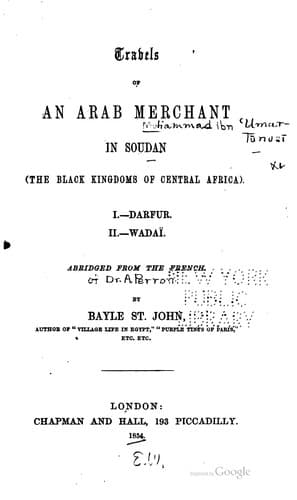
Travels of an Arab merchant in Soudan (the Black Kingdoms of Central Africa)Tūnisī, Muḥammad ibn ʻUmar
History
Travels of an Arab merchant in Soudan (the Black Kingdoms of Central Africa)
Tūnisī, Muḥammad ibn ʻUmar
Darfur (Sudan) -- Description and travel; Wadai (Sultanate) -- Description and travel
spoken respectfully, like a son to his father, I reminded him of
his promise, and told him that I had no longer either provisions or
money; that the price of the slave sold was spent; and that I had no
longer even wherewith to eat. One of my guards carried this letter,
and returned soon afterwards with an answer, in which, after the
usual form of politeness, he said to me:—“A prudent man puts by
sufficient for the hour of want. Do as thou pleasest. I have begged
permission for thee of the Sultan, and thereby roused his anger,
so that he gave me no direct answer. Wait until God creates more
favourable circumstances. His providence watches over all. Know,
also, that if thou wert not of the noble blood of the Shereefs it
would have gone harder with thee. Salutations.”
On receiving this letter I was overwhelmed with grief; but
resignation was the only thing left to me. Some days afterwards,
two slave-girls and a male slave escaped from my prison. Then I
repented me that I had not already sold all my slaves. Their flight
drove me to despair, and I was devoured by disquietude; but I wrote
no more to Fakih Malik. I had now only left a slave-woman, blind of
one eye, who had been the concubine of my uncle, another woman, who
was my own concubine, and two Sedasy slaves. One morning I missed
my concubine. She also had fled. This last blow was too much. I
felt like the bird that has no longer any means of escaping from
its cage. I called the chief of my guards, and related to him my
sorrows. He was saddened, and he sighed and groaned, and, at the
same time, endeavoured to console me.
When the night came I went out with one of my guards, once more
determined to seek an interview with Malik, and to lay my case
before him. We had not gone far when a troop of horsemen came
riding down the street, and were close upon us before we observed
them. The Sultan himself was making his rounds through the city,
and distributing patrols and guards to prevent spies from penetrating
into the capital. Whoever on these occasions was found, without being
able to give a good account of himself, was put to death. Many thus
lost their lives. The expedition of the people of Wadaï against
Tamah was the reason of this unusual rigour.
When we were met by the cavalcade of the Sultan, some one cried
out,—
“Who goes there?”
I answered, “The Shereef, son of the Shereef Omar of Tunis.”
“Stop,” said the horseman; “here is the Sultan.”
I stood still, and the troop gathered round me, reining in their
horses. I was alone, for my companion, at the first sound of the
trampling of hoofs, had fled away like a bird. The Sultan drew
nigh. Happily for me there was with him one of his viziers, with
whom I was intimately united in friendship, named Suliman Tyr. Then
the Sultan said to me,—
“Who art thou?”
And the man who had hailed me at once put in,—“This is the man
whose father is at Wadaï.”
“And why art thou abroad at this hour?” said the Sultan.
Public-domain text, read in full here on John Shaqi.
Reviews
Reviews
No reviews yet
Be the first to share your thoughts on this work.
Elsewhere in the archive
Join the Discussion
Join the discussion
Sign in to leave a comment or review.
Sign InorCreate an account