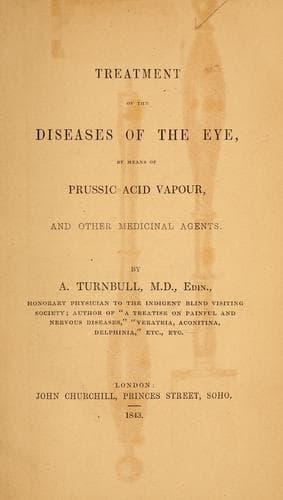
Treatment of the diseases of the eye, by means of prussic acid vapour, and other medicinal agentsTurnbull, Alexander
Science
Treatment of the diseases of the eye, by means of prussic acid vapour, and other medicinal agents
Turnbull, Alexander
Eye -- Diseases; Hydrocyanic acid -- Therapeutic use
One reason why I did not rest satisfied with the effects produced by
the hydrocyanic acid, was, that its action, like that of all other
medicines, decreased in power by continued application; thereby
rendering it necessary to have occasional recourse to other medicines,
in order to insure a more speedy recovery. Another reason was, the
reluctance of many individuals to submit the eye to the action of so
potent a medicine.
The first medicines to which I shall refer, and which I have employed
with some success, are the _chlorocyanic acid_ and _sulphuretted
chyazic acid_. The plan I pursue is that of putting a drachm of one
of the medicines into a bottle (containing a small piece of sponge) of
about two-ounce size, having a mouth precisely fitted to the eye, and
with a ground-glass stopper.
The action of these medicines is very different from that of the
_hydrocyanic acid_, in as far as they both stimulate the eye, and
produce much greater warmth and irritation, with less dilatation of the
pupil. Few, however, can bear the _chlorocyanic acid_ to be applied
longer to the eye than half a minute; though, in a minute after its
application, all irritation is removed, and the eye feels perfectly at
ease.
The next medicine which I have employed in the form of vapour was the
chloruret of iodine. This medicine produces very little warmth or
uneasiness to the eye, if continued for the space of two minutes or
upwards; but a sensation of irritation, accompanied with a flow of
tears, takes place on its removal. It contracts the pupil, and in no
case have I seen it dilate it. Its vapour rises very readily, and does
not leave the yellow disagreeable colouring on the skin produced by the
vapour of iodine when uncombined, which is a great drawback in the use
of iodine in diseases of the eye.
The last medicine which I have employed is the bisulphuret of carbon,
which is so volatile, that the application of it to the eye, when the
bottle is held in a warm hand for a few seconds, is as much as can be
borne, in consequence of the intense prickling heat and flow of tears
which it occasions. Owing to this fact, I generally use it by causing
the patient to shut the eyelid during its application, which can then
be continued for a minute or two, with the same beneficial effect upon
the eye, without inconvenience to the patient. It generally contracts
the pupil, and very seldom dilates it.
I used to employ iodine by putting it into the same bottles, and
immersing it in hot water, and in its state of vapour applying it to
the eye; but I find it answers much better when dissolved in the
bisulphuret of carbon.
Public-domain text, read in full here on John Shaqi.
Reviews
Reviews
No reviews yet
Be the first to share your thoughts on this work.
Join the Discussion
Join the discussion
Sign in to leave a comment or review.
Sign InorCreate an account