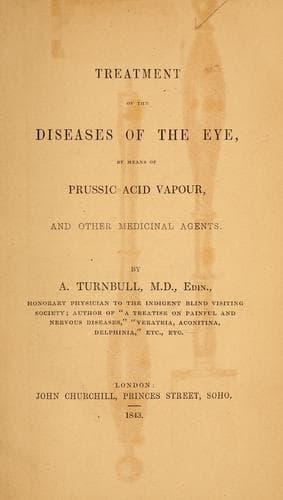
Treatment of the diseases of the eye, by means of prussic acid vapour, and other medicinal agents — John Shaqi
Treatment of the diseases of the eye, by means of prussic acid vapour, and other medicinal agentsTurnbull, Alexander
Science
Treatment of the diseases of the eye, by means of prussic acid vapour, and other medicinal agents
Turnbull, Alexander
Eye -- Diseases; Hydrocyanic acid -- Therapeutic use
It is my intention, shortly, to give a full account of the action of
these medicines upon the various forms of disease to which the eye
is subject, and also what particular disease each medicine is best
calculated to remove. At the same time I shall state such instances
of failure as have occurred in my experience, in order that a just
estimate may be formed of the value and importance of each medicine.
It may not be out of place here to state, that I have employed,
with great success, the bisulphuret of carbon to enlarged indurated
lymphatic glands. In the first instance, I rubbed equal quantities of
the bisulphuret of carbon and alcohol upon the parts affected, but
without any effect upon the glands. But as its effects were so great
when its vapour was confined to the eye, I was led to apply it in the
form of vapour, and by means of glass bottles similar to those I have
described. By these means I excluded the action of the medicine from
the external air, and thereby prevented its speedy evaporation. When it
had been applied about one minute, the patient felt the part very cold,
but immediately after a gradual heat, accompanied with great prickling;
the heat increasing the longer the medicine was kept in contact with
the part, until it could be no longer endured. On removing the glass,
the part was red to an extent two or three times greater than the part
enclosed. In a few days the change in the size of the glands was very
great; and by its daily repetition, a complete and speedy removal of
the disease was effected. I also find that its action upon diseased
glands is more decided if the surface of the skin is well moistened
with water previous to the application of the bottle to the part.
The water, in fact, not only prevents the escape of the vapour between
the glass and the skin, but assists the imbibition of the carbon; a
point of the highest importance, inasmuch as all its action on the part
depends upon the exclusion of the atmosphere from the vapour. I may
here observe that these applications occasion no injury whatever to the
skin.
I have also found the _bisulphuret of carbon_, and the chlorocyanic
acid, valuable medicines in the removal of deafness, depending upon
a want of nervous energy and deficiency of wax. The mode of its
application is substantially the same as that which I employ in
diseases of the eye, with this difference only, that the bottle is
formed with a small neck and stopper adapted to the size of the orifice
of the ear, and held close to the organ until a considerable degree of
warmth is produced.
The action of these medicines, which contain so large a share of
carbon, arises from the carbon in the vapour permeating the cuticle,
and coming in contact with the oxygen in the vessels, which is conveyed
through every part of the frame by inspiration and otherwise, and
thereby forming carbonic acid gas, which evolves heat in the ratio of
the quantity consumed by the oxygen.
Public-domain text, read in full here on John Shaqi.
Reviews
Reviews
No reviews yet
Be the first to share your thoughts on this work.
Join the Discussion
Join the discussion
Sign in to leave a comment or review.
Sign InorCreate an account