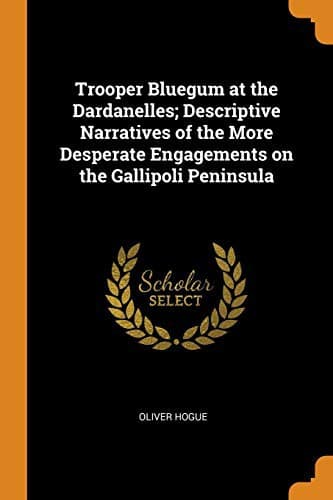
Trooper Bluegum at the Dardanelles: Descriptive Narratives of the More Desperate Engagements on the Gallipoli PeninsulaHogue, Oliver
History
Trooper Bluegum at the Dardanelles: Descriptive Narratives of the More Desperate Engagements on the Gallipoli Peninsula
Hogue, Oliver
World War, 1914-1918 -- Campaigns -- Turkey -- Gallipoli Peninsula; World War, 1914-1918 -- Personal narratives, Australian
I feel the blood coursing through my veins as I have never felt it
before. I live in the present, but the past stands up before me. Dead
kings and emperors pass in endless succession. Libyans and Ethiopians
pass by, Assyrians and Macedonians, Babylonians and Persians, Romans,
Arabs, Turks and Mamelukes--and French and British. Great names are
sprinkled over the pages of Egypt, from Menes, the first king, and
Rameses the Second, down to the present day. Nebuchadnezzar and
Alexander the Great, Constantine, Saladin and Napoleon, Mohammed Ali
and Kitchener have all left their mark on the Nile Delta. What history!
and here are we--soldiers of King George V, from Australia--treading
this historic ground, making new history. Nebuchadnezzar knew us not.
Constantine never dreamed--and they used to dream dreams in those
days--that from a land he knew not of would one day come armed men
marching on the wonderful city he built.
Nor did I, nor did any of us, know it--well, not yet.
I know what it means to see the blush clouds beating the night shades
back in the van of a golden morning, but there is a quality of richness
about the sunrises of Egypt that Australia lacks. Egypt has the glint
of gold, the cloud ridges of rosy red, the blaze of amethyst and
opal. So also has the Australian sky. But Australia has no pyramids.
The first beams of the sun in this land tip the cones of the age-old
pyramids, and soon these drab giants shine like molten copper. Then the
sky turns all gold, and the scene is duplicated in the placid bosom of
the ancient Nile, which skirts our camp. In the murky distance the
desert is shrouded in a misty haze which has the same blue that one
sees in the distance on the Blue Mountains of New South Wales, but once
the sun is fairly above the horizon, the brilliant transformation scene
dissolves itself into a glaring white light that lasts till sunset.
Then the morning's glory is reenacted with softer tones and a riot of
colour that I can never describe.
Then, as the Pyramids of Gizeh were due west from Ma'adi, we always saw
these giant triangles sharply silhouetted against the red horizon. They
looked like little toy tents, yet when alongside them their magnitude
staggered us.
The day was so hot that helmets were necessary. Some "went down" under
the fierce rays of the sun, but there were some with us who said it was
not hot at all. They spoke of the sun-baked Western Plains. They spoke
of Bourke. They spoke of Northern Queensland. But they wore helmets,
nevertheless.
Yet was Ma'adi, for all its heat, a joy to the senses. If we had the
everlasting desert wilderness on one side, we also had the oasis of
Ma'adi on the other. The irrigationist has caused the desert hereabout
to blossom as the rose, and Ma'adi is like an English village, with
gracious gardens and green, luscious fields and rippling canals.
Public-domain text, read in full here on John Shaqi.
Reviews
Reviews
No reviews yet
Be the first to share your thoughts on this work.
Join the Discussion
Join the discussion
Sign in to leave a comment or review.
Sign InorCreate an account