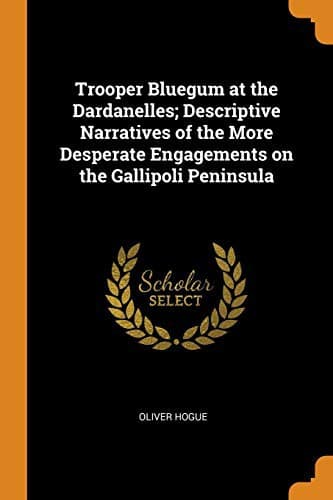
Trooper Bluegum at the Dardanelles: Descriptive Narratives of the More Desperate Engagements on the Gallipoli Peninsula — John Shaqi
Trooper Bluegum at the Dardanelles: Descriptive Narratives of the More Desperate Engagements on the Gallipoli PeninsulaHogue, Oliver
History
Trooper Bluegum at the Dardanelles: Descriptive Narratives of the More Desperate Engagements on the Gallipoli Peninsula
Hogue, Oliver
World War, 1914-1918 -- Campaigns -- Turkey -- Gallipoli Peninsula; World War, 1914-1918 -- Personal narratives, Australian
Passing by the rugged Socotra, we soon sighted the mountainous southern
coast of Arabia, and by midday on January 20 we were focussing our
binoculars on the picturesque gate of the Indian Ocean, Aden. Curious
it is how Britain has secured all the great strategical points of the
world--Gibraltar, Suez, Aden, Singapore, Thursday Island, the Cape of
Good Hope, and the rest. And one has only to see Aden, with its rocky
peaks piercing the skyline, to realize how strong it is, and how futile
would be any effort to capture it. For all the defences of Aden seem to
be hewn out of solid granite.
No sooner had we got anchored in the harbour than the _Suevic_ was
surrounded by swarms of boats, in which were crowded Asiatics of all
descriptions yelling like demons in wild anxiety to sell their wares.
Then the colliers came alongside and proceeded to coal. Scores of thin,
undersized, but wiry Arabs did the work, and as they loaded the bunkers
they kept up a perpetual yelling and singing, and the weird cacophony
lasted all through the night.
Aden is a curious mixture of the Orient and the Occident. In the
streets silent Arabs stalk along with camels, and Europeans buzz
around in automobiles. One section of the port belongs to the Asiatics;
the other is all Western. Arab dhows float across the harbour and steam
tugs scurry hither and yon. One section of the town has thatched roofs;
the other is all galvanized iron. And one of the natives sang us "Songs
of Araby." They yelled harshly for baksheesh all the while. Clad in
their own coloured loin cloths, or in discarded khaki tunics from the
Force, they were a motley tatterdemalion crowd. Here East and West
met--but did not mingle.
We had had no word of news for weeks. So we eagerly searched for
the newspapers, and demanded news of the outer world. The war was
still on. The Allies were more than holding their own. Here was news
indeed!--news such as _The Transport Trumpeter_ (published aboard the
_Suevic_) had never heard of. Yet we loved that little paper of ours
on the transport--"a little thing, but our own." If it lacked news it
did not lack reporters whose imagination made up for the deficiency.
We were all reporters for _The Transport Trumpeter_. Even I. And I am
wondering to this day about a certain curious coincidence connected
with one of my painstaking efforts. I wrote on December 28, 1914, a
skit on Lissauer's "Hymn of Hate," and Arthur Adam's reply to it--"My
Friend, Remember." A month later I got the Sydney _Bulletin_, and there
I saw almost exactly the same article with the same excerpts from each
poem. They were probably written on the same day, a thousand miles or
so apart. You who delve into the mysterious, will you explain?
* * * * *
Egypt! What memories! What life here! What a quest we have set out
upon! What Alexanders are we!
Public-domain text, read in full here on John Shaqi.
Reviews
Reviews
No reviews yet
Be the first to share your thoughts on this work.
Join the Discussion
Join the discussion
Sign in to leave a comment or review.
Sign InorCreate an account