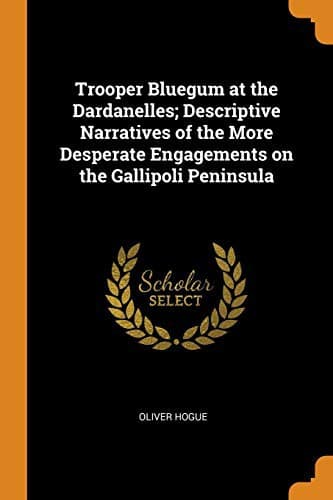
Trooper Bluegum at the Dardanelles: Descriptive Narratives of the More Desperate Engagements on the Gallipoli PeninsulaHogue, Oliver
History
Trooper Bluegum at the Dardanelles: Descriptive Narratives of the More Desperate Engagements on the Gallipoli Peninsula
Hogue, Oliver
World War, 1914-1918 -- Campaigns -- Turkey -- Gallipoli Peninsula; World War, 1914-1918 -- Personal narratives, Australian
Meantime a more vigorous assault was made at Toussoum to pierce the
line just before daybreak. An infantry attack was followed by artillery
fire, and under cover of the maxims a more determined effort was made
to cross the Canal by means of boats, rafts, and pontoons. A shrapnel
shell smashed the first boat and killed several Turks. Other boats
followed and met with a similar fate--most of their occupants were
killed or drowned. Not a single boat crossed. About twenty-five men
swam across, however. Four penetrated the lines and escaped to Cairo,
where they subsequently surrendered. The rest were captured.
Serapeum was attacked about the same time, and at dawn the battle raged
along the Canal for about two and a half miles. H.M.S. _Hardinge_
moved up and down the Canal, responding to the enemy's artillery. Two
Turkish shells landed on our warships, and ten men were wounded. For a
couple of hours the battle raged, and although the Turks outnumbered
the defenders at Toussoum by ten to one, they were repulsed all along
the line.
Further north, at Ismailia Ferry, the enemy entrenched 800 yards away,
and a battalion of Turkish infantry (entrenched overnight) opened
fire. But they did little damage. They blazed away all day, and our
casualties were only six men wounded. Then we drove them off.
So the great Germano-Turkish attack resolved itself into simultaneous
onslaughts at Kantara, Ismailia, Toussoum and Serapeum; and when all
attacks had failed the guns of the British and French cruisers and
the shore artillery harried the enemy in their retreat and added
considerably to their losses. Our casualties were only about twenty
killed and 100 wounded. The invaders lost more than 420 men killed
and over 700 prisoners. Their total casualties--killed, wounded, and
prisoners--were computed at 3,000.
Yet it was a small thing, after all--a small thing when I look back and
think of all that has happened since. But it was the first fight in
the Great War that Australians and New Zealanders had a hand in.
We of the Light Horse were not in it. We saw the Turks away on the rim
of the desert horizon; but the enemy attacked where we were not. We
never fired a shot.
CHAPTER IV
IN EGYPT STILL
LOCUSTS AND EGYPTIAN NIGHTS--THE GREAT BARRAGE--IRRIGATING THE
DELTA--THE SCOT AGAIN--EGYPTIAN ROADS--ARABIAN NIGHTS--CAIRO BY
NIGHT--A MAGIC OF COLOUR--"A SOUND OF REVELRY BY NIGHT"--THE "GRANDE
FÊTE DU 75."
Yes, we were biding our time in Cairo; and I am telling no secrets when
I say that the Australians swore terribly in Cairo. We had left our
happy homes in order to take part in the war, and here we were burning
our heels on the Egyptian sand--day after day, week after week. No
wonder many of us, as we tramped along on a route march to Helwan on
the day preceding Good Friday, said we would prefer to be spending the
day at the Royal Easter Show in Sydney.
Public-domain text, read in full here on John Shaqi.
Reviews
Reviews
No reviews yet
Be the first to share your thoughts on this work.
Join the Discussion
Join the discussion
Sign in to leave a comment or review.
Sign InorCreate an account