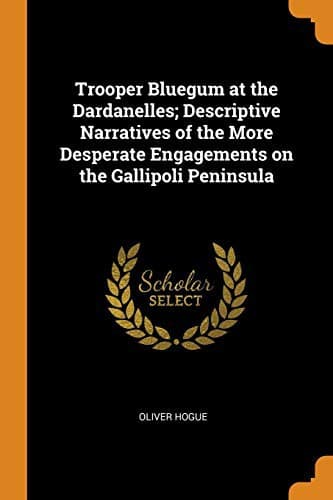
Trooper Bluegum at the Dardanelles: Descriptive Narratives of the More Desperate Engagements on the Gallipoli Peninsula — John Shaqi
Trooper Bluegum at the Dardanelles: Descriptive Narratives of the More Desperate Engagements on the Gallipoli PeninsulaHogue, Oliver
History
Trooper Bluegum at the Dardanelles: Descriptive Narratives of the More Desperate Engagements on the Gallipoli Peninsula
Hogue, Oliver
World War, 1914-1918 -- Campaigns -- Turkey -- Gallipoli Peninsula; World War, 1914-1918 -- Personal narratives, Australian
On the right of our line of march lay the Nile with its green strip of
verdure on either side, and a dozen pyramids out westward. The day was
as hot as a furnace. The mirage seemed to shimmer on the rim of the
earth, and horsemen, camels and Bedouins a few miles away seemed to
be floating in the air. Like white wings gliding up and down the Nile
were the triangular sails of the native dhows--wonderfully picturesque,
with their tremendous spars that tower into the sky. At old Cairo there
was a veritable forest of masts. The rudders of these river boats are
huge things, and the noses are painted in gaudy colours, and are always
turned up disdainfully, as if they had been bumped against a pier.
You had heard of the Plagues of Egypt; we have seen them, and are able
to vouch for the authenticity of the Scriptures. Instead of hot cross
buns, Easter brought us a plague of locusts. The entertainment started
at about three o'clock in the afternoon and lasted till after sundown.
Millions and billions and quadrillions of locusts danced and sang for
us. The air was absolutely full of them, darkening the sun--big yellow
and brown and black things, mostly about two inches long. They sounded
like thousands of whirring wheels, and they dropped on the roofs with a
noise like rain. Where they landed they left everything bare as a bone.
All along the Nile the "gyppies" turned out and banged tin cans to
drive them off. Here was an invasion, if you like! The telegraph wires
were black with them--like long beads. Some of the beautiful Ma'adi
gardens were quite spoilt. These locusts of Egypt have absolutely no
love for the beautiful--in fact, the more beautiful a thing is the more
delight do they take in devouring it.
But even a plague of locusts does not last for ever--and Egypt does.
Egypt the wonderful! Egypt the kaleidoscopic! No, gentle reader, do
not waste your sympathies on us. It was tiresome work, marching,
training--training for the front, which for months never seemed to get
any nearer, and some of "the boys"--those of them who were "spoiling
for a fight," as the saying is--used at times to kick over the traces
and paint the town vermilion; but there are compensations in Egypt
for all who would seek them. What did it matter that we had no hot
cross buns for Easter, no hard-boiled eggs, no ling, no salmon? We had
omelettes and quail on toast, and chicken and curry and strawberries
(no cream) and oranges and custard and jelly and Turkish coffee and
Nile fish and pancakes and fritters and iced butter and beautiful jam
and marmalade--and cigars. So we managed to get "a snack," you see.
And I know that I, for one, had no desire just then to swap places with
any man in Australia.
Public-domain text, read in full here on John Shaqi.
Reviews
Reviews
No reviews yet
Be the first to share your thoughts on this work.
Join the Discussion
Join the discussion
Sign in to leave a comment or review.
Sign InorCreate an account