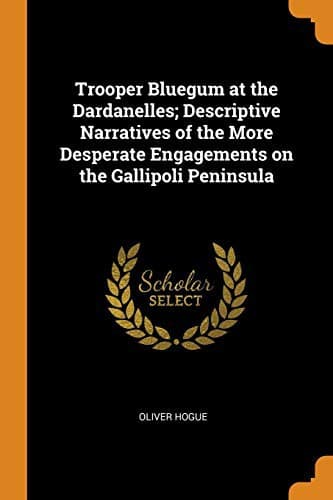
Trooper Bluegum at the Dardanelles: Descriptive Narratives of the More Desperate Engagements on the Gallipoli PeninsulaHogue, Oliver
History
Trooper Bluegum at the Dardanelles: Descriptive Narratives of the More Desperate Engagements on the Gallipoli Peninsula
Hogue, Oliver
World War, 1914-1918 -- Campaigns -- Turkey -- Gallipoli Peninsula; World War, 1914-1918 -- Personal narratives, Australian
We had a final concert in the cinema tent, and it was a huge success.
The good folk of Ma'adi rolled up in full force. Charles Knowles, the
famous baritone, came out and sang "The Trumpeter" and "My old Shako"
and "The Old Brigade" and "Land of Hope and Glory," and we all joined
in the choruses. The brigadier made a farewell speech, and thanked the
residents for all their kindness to the men of the 2nd Brigade. He
said we were sorry to part with such good friends, but were glad at
last to have a chance of striking a blow for freedom and justice and
the grand old flag of the Empire. Of course, we cheered all the time,
and we laughed when genial Mr. Hopkins, President of the Citizen's
Committee, farewelled us with the words, "God bless you" and "God help
the Turks if you get at them with the bayonet."
We marched away at last. British folk at Ma'adi and Cairo were
enthusiastic, and gave us a great farewell. Some of the "gyppies"
and Arabs along the roadway were sullenly passive and apathetic. At
the main station, Cairo, crowds of soldiers assembled to cheer the
horseless horsemen. "We went to South Africa as infantry, and they
mounted us," said a philosophic Riverina grazier. "Now, we come to
North Africa as Light Horsemen, and they bundle us off as infantry."
We profited by the experience of the infantry. Our officers dressed
exactly like the men. They carried rifles and wore bandoliers. All
their pretty uniforms that they "swanked" in at the continental dances
and dinners went by the board, and they roughed it in service jackets
and hobnailed boots.
Seen from aloft, the 2nd Light Horse embarking resembled nothing
so much as a swarm of khaki ants covering the quays at Alexandria.
They scurried hither and thither, and to the onlooker it seemed all
confusion worse confounded by the arrival of additional trains from
Cairo.
But the confusion was more apparent than real. One noticed soon that
all the soldiers going to the transports were loaded with arms and
ammunition and stores. Those coming from the ships were empty-handed.
And soon the trains rattled off, the wharves were cleared and all the
troops were aboard. But there were no fond farewells this time. All the
folk who were near and dear to us were far, far away. A coffee stall
on the quay "manned" by the Y.W.C.A. worked overtime from four o'clock
in the morning, and our fellows were very grateful to the ladies of
Alexandria who did us this kindness. They wished us "Good luck," and
we glided out. There were no cheers or sirens to hearten us. That
was all past. We were starting off in grim earnest this time. A few
embarkation officers and transport officials on the wharf called out
"Good luck, boys"; and that was all.
Public-domain text, read in full here on John Shaqi.
Reviews
Reviews
No reviews yet
Be the first to share your thoughts on this work.
Join the Discussion
Join the discussion
Sign in to leave a comment or review.
Sign InorCreate an account