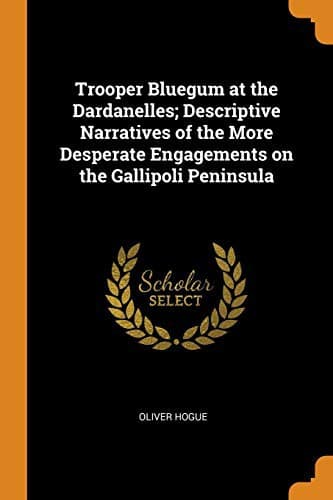
Trooper Bluegum at the Dardanelles: Descriptive Narratives of the More Desperate Engagements on the Gallipoli PeninsulaHogue, Oliver
History
Trooper Bluegum at the Dardanelles: Descriptive Narratives of the More Desperate Engagements on the Gallipoli Peninsula
Hogue, Oliver
World War, 1914-1918 -- Campaigns -- Turkey -- Gallipoli Peninsula; World War, 1914-1918 -- Personal narratives, Australian
Half an hour later we were out on the Mediterranean--the blue
Mediterranean--and we thought of all the fleets that in the centuries
gone by had sailed these waters--Greeks, Romans, Carthaginians,
Spaniards, Turks, French and British. Our ship was numbered A25--the
_Lutzow_, one of the many German liners that had fallen to the mighty
British Navy. And on board were crowded 2,000 men. No horses! Our
gallant steeds had all been left behind at Ma'adi, ready to follow the
moment we drove the Turks from the hills and reached "cavalry country."
Our boys had had the chance of coming without horses or stopping
behind; they never hesitated for a moment.
"Submarine," whispered some one the first day out. And all eyes
searched the waters round us. But no submarine had been seen. We had
simply been warned that there was a Turkish submarine somewhere outside
the Dardanelles. So the brigadier, Colonel Ryrie, took steps to give
it a warm reception in case it poked its nose--its periscope--above the
surface of the sea.
The whole brigade was remarkably happy. Despite the fact that within
a couple of days these men would be fighting for their lives, despite
the fact that their comrades of the Australian Infantry had just
suffered 4,000 casualties in four days, they went as cheerily forward
as their relations in Sydney went to the Easter Show. And that reminds
me that right here near the Dardanelles I came across a copy of the
Easter number of the _Sydney Mail_. What a joy it was to escape the war
pictures for a brief while and see, instead, the photographs of prize
pumpkins, of milking shorthorns, and the great stock parade, and the
high jump, and all the other attractions of one of the greatest shows
on earth! It was just like a message of good cheer from sunny New South
Wales.
We had left Alexandria under sealed orders. We had to meet a certain
warship in a certain place and get certain instructions. We travelled
at night with all lights out, and threaded our way with care through
the Archipelago. Passing Rhodes and Crete and Tenedos, we reached the
scene of what has been described as the most picturesque phase of the
Great World War--the attack on the Dardanelles.
There had been many changes in the brigade, since the men first went
into camp at Rosebery Park, Sydney, nine months before. Nearly a
thousand men passed through Colonel Cox's regiment before it finally
started out to smash the Turk and thrash the Hun. There had been
changes also amongst the officers, and as the exact list has never
been published and many of these officers were soon to lay down their
lives in the service of their country, let me give their names here--a
permanent record which will be cherished by those officers and men who
remain and by the families of all the brave dead.
Public-domain text, read in full here on John Shaqi.
Reviews
Reviews
No reviews yet
Be the first to share your thoughts on this work.
Join the Discussion
Join the discussion
Sign in to leave a comment or review.
Sign InorCreate an account