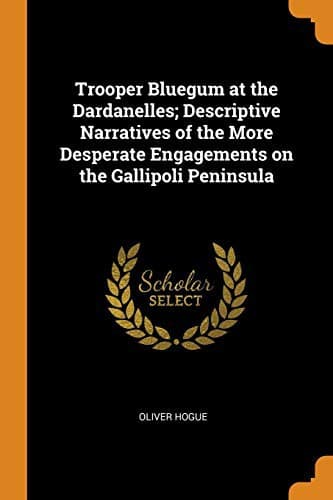
Trooper Bluegum at the Dardanelles: Descriptive Narratives of the More Desperate Engagements on the Gallipoli PeninsulaHogue, Oliver
History
Trooper Bluegum at the Dardanelles: Descriptive Narratives of the More Desperate Engagements on the Gallipoli Peninsula
Hogue, Oliver
World War, 1914-1918 -- Campaigns -- Turkey -- Gallipoli Peninsula; World War, 1914-1918 -- Personal narratives, Australian
That _Peninsula Press_, little thing though it was, used to be read
and re-read till we could almost repeat all its contents word for
word. It gave us the war news on all fronts in a nutshell. In this
particular number we read of the great Russian victory in East Galicia,
when the Austrians were pushed back from the Dniester to the Pruth,
and on a 100-mile battle-front the Russians took 20,000 prisoners in
five days. We read of von Bethmann-Hollweg's threat to Italy--his
threat to punish Germany's "faithless ally" who had seen fit to
throw over the Powers of Darkness for those of Light and Freedom and
Civilization. We read of the German losses between Steenstraete and
Ypres, despite their use of asphyxiating gas which their enlightened
scientists had been able to place at their disposal. We read this:
"The British Navy has rescued 1,282 German seamen and marines from
German warships sunk. Not one British seaman or marine has been saved
by Germans in like circumstances." We read an extract from the Greek
newspaper _Athinai_ relating to the elections in that country: "If
the people give the victory to the party of M. Venizelos, then the
Entente Powers will have no further anxiety concerning us; Greece will
be ready for war in accordance with the programme of M. Venizelos and
with the engagements he has assumed." (And the people did give the
victory to M. Venizelos--but Greece, oh, where was she?) And this also
we read in our paper: "The people of Gallipoli Town," says a Turkish
correspondent, "have seen only four British (Australian) prisoners of
war. The men excited great admiration among the people, because it
was seen that they were indeed soldiers. They wandered about freely
and drank coffee, creating great excitement by their queer remarks
and causing no ill-feeling." And the _Lusitania_! We read the lines
from _Punch_ of May 12--Britain to America, on the sinking of the
_Lusitania_:
In silence you have looked on felon blows,
On butcher's work of which the waste lands reek;
Now, in God's name, from Whom your greatness flows,
Sister, will you not speak?
We ourselves had seen a ship go down. We saw the _Triumph_ torpedoed.
We saw her shiver from stem to stern--and then go down in the sea. She
was a triumph of man's handiwork, and man's handiwork had destroyed
her. The sea was very calm, but submarines and mines lurk in still
waters as well as rough--and out of the calm sea came the thing of
death. From the moment she was struck till she turned turtle but
fourteen minutes elapsed. A dozen launches and torpedo boats rushed
to rescue the crew, and all were saved except about forty. And we who
saw it all from the trenches looked on at it stupefied. With a mighty
lurch--as it were a giant in the agonies of death--the _Triumph_ heeled
over and was gone.
Such things are done, and will be done, as long as there are Hymns of
Hate in the world. War is a gruesome business.
Public-domain text, read in full here on John Shaqi.
Reviews
Reviews
No reviews yet
Be the first to share your thoughts on this work.
Join the Discussion
Join the discussion
Sign in to leave a comment or review.
Sign InorCreate an account