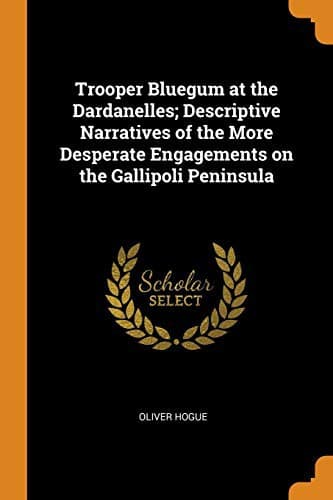
Trooper Bluegum at the Dardanelles: Descriptive Narratives of the More Desperate Engagements on the Gallipoli PeninsulaHogue, Oliver
History
Trooper Bluegum at the Dardanelles: Descriptive Narratives of the More Desperate Engagements on the Gallipoli Peninsula
Hogue, Oliver
World War, 1914-1918 -- Campaigns -- Turkey -- Gallipoli Peninsula; World War, 1914-1918 -- Personal narratives, Australian
Life in the trenches became quite bearable--after a time. But it took
time. At first when a bullet skimmed the parapet and went whistling
overhead we ducked instinctively. But the experienced infantry laughed,
and said, "They're only 'canaries'." Again, when the shrapnel came
hurtling aloft and burst with an ugly roar, we crouched and waited for
death; but the old hands explained that if we could hear it burst we
were pretty safe. It was the shells we couldn't hear that we ought to
dodge. We understood that epigrammatic utterance better later on.
But one thing is absolutely essential for a philosophic enjoyment of
trench life--and that is a sense of humour. Failing that, most of the
soldiers would in the end go stark, staring mad. It is this saving
grace which makes our Australians such a wonderful fighting force. They
go laughing into the firing-line. They come laughing out again. They
laugh as they load and fire. Nearly every wounded man I've seen laughs.
A staff officer said the other day: "It's only when they're killed that
these Australians cease laughing."
Our three Australian Light Horse brigades have now been in the trenches
for some time. "We came to Egypt as horsemen," said a Hunter River
man; "then we did foot-slogging at Cairo and Alexandria, and now we're
living in caves and tunnels, like rabbits or troglodytes."
Since the days of Darwin quite a lot has been written about evolution.
But we never thought of evolution in connexion with our Light Horse
Brigade. We soon found that we couldn't escape the process any more
than the rest of the universe.
One would have thought that as new and awful weapons of destruction
were evolved, battles would become short, sharp, and decisive. Instead
of that, they are toilsome, long-drawn-out, and indecisive. I cannot
say why. The elucidation of the problem I leave to the "experts." All
I am concerned with is the story of how the 2nd Light Horse Brigade
became the Lost Horse Brigade. Australia sent four Light Horse brigades
to uphold the honour of the Commonwealth; first, Colonel Chauvel;
second, Colonel Ryrie; third, Colonel Hughes; fourth, Colonel Brown.
At first we thought we were going to be armed with swords as well as
rifles. When first mounted, despite our sombre khaki, we felt as proud
as Life Guardsmen. And we saw visions and dreamed dreams, and pictured
the Australian Light Horse on the left wing of the Empire army driving
the Huns in confusion over the Rhine and back to Berlin.
Hope on, hope ever. All we have done so far is, by process of
devolution, to change from prospective cavalry to mounted infantry, to
foot-sloggers, to pick and shovel artists, and finally to troglodytes.
The pen is mightier than the sword--but so is the spade.
Public-domain text, read in full here on John Shaqi.
Reviews
Reviews
No reviews yet
Be the first to share your thoughts on this work.
Join the Discussion
Join the discussion
Sign in to leave a comment or review.
Sign InorCreate an account