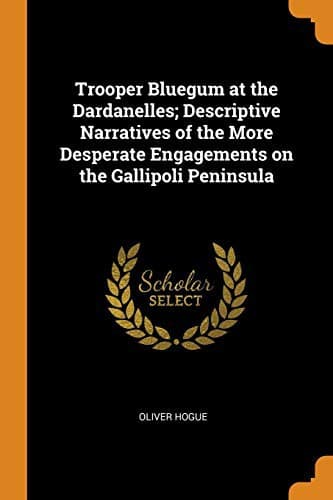
Trooper Bluegum at the Dardanelles: Descriptive Narratives of the More Desperate Engagements on the Gallipoli PeninsulaHogue, Oliver
History
Trooper Bluegum at the Dardanelles: Descriptive Narratives of the More Desperate Engagements on the Gallipoli Peninsula
Hogue, Oliver
World War, 1914-1918 -- Campaigns -- Turkey -- Gallipoli Peninsula; World War, 1914-1918 -- Personal narratives, Australian
We did not like the packs at first. Our horses used to carry our kits,
and it was rather irksome to be transformed suddenly into beasts of
burden. Also, we imbibed a new respect for the infantry, who seemed
to carry their heavy packs with consummate ease. Ours at first felt
like the Burden to Christian. But gradually we, too, developed the
necessary back and shoulder muscles for the infantryman's job. We
trudged up and down the hills of Anzac; we filed into the trenches and
took our stations at the loopholes; on the day of the armistice we
helped to bury the dead Turks whom Enver Pasha had ordered to drive
the Australians into the sea. Then it was that the infantry, seeing "2
L.H.B." on our shoulder straps, called us the 2nd _Lost_ Horse Brigade.
But we didn't mind losing our horses so long as we had a finger in the
Gallipoli Pie. Trench warfare suited us well enough. The firing-line
was always interesting. Everybody was light-hearted. Jokes and laughter
passed the time pleasantly when we were not sniping or observing. It
meant a little more work when the Turkish (or German) guns smashed in
our parapets and half-choked, half-blinded and half-buried us. Now and
then some of our chaps stopped a bullet or a bit of shrapnel. But we
dealt out more than we got. Every day the Officer Commanding and the
Brigadier made a tour of the firing-line, while we often had three
generals to see us on special days. The day after the big attack
General Birdwood asked one of the 1st Light Horse Regiment if he had
killed many Turks, and he answered, "Yes, miles of the cows."
As a matter of fact the Australians were almost quarrelling for
positions in the firing-line that night. When the fight was at its
hottest, men in the supports were offering bribes of tobacco and
cigarettes to the men in the firing-line to swap places with them just
for ten minutes. Our night patrols had great fun harassing the enemy;
but for the bulk of us it got monotonous. It was nothing but dig new
saps, new tunnels, new trenches, day after day and night after night.
The 6th Light Horse Regiment changed its badge and its motto. When we
left Sydney we had beautiful badges with a fighting cock and the motto
"Fight on, fight ever." We've got a new badge now--pick and shovel,
argent, crossed on an azure shield, and our new motto is "Dig on, dig
ever."
The 7th Light Horse Regiment also changed its motto, which used to be
"Patria te Salutamus." Now the troopers sport a shield with a picture
of a rabbit, and Colonel Arnott's new motto is "Infra dig. Tunnelabit."
The A.L.H. did their share of the trench fighting quite as well as
their infantry comrades. Day after day they took their posts as
observers or snipers. Night after night they manned the loopholes or
did patrol work or sapping. When off duty they bolted to Anzac Cove,
and all the shrapnel shells in the world didn't keep them out of the
water.
Public-domain text, read in full here on John Shaqi.
Reviews
Reviews
No reviews yet
Be the first to share your thoughts on this work.
Join the Discussion
Join the discussion
Sign in to leave a comment or review.
Sign InorCreate an account