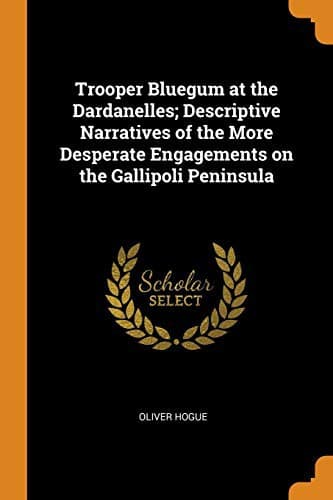
Trooper Bluegum at the Dardanelles: Descriptive Narratives of the More Desperate Engagements on the Gallipoli PeninsulaHogue, Oliver
History
Trooper Bluegum at the Dardanelles: Descriptive Narratives of the More Desperate Engagements on the Gallipoli Peninsula
Hogue, Oliver
World War, 1914-1918 -- Campaigns -- Turkey -- Gallipoli Peninsula; World War, 1914-1918 -- Personal narratives, Australian
"Curse our luck!" That was moderate.
But when Trooper Newman said, "To hell with the ship!" most of us felt
that he showed a proper appreciation of the position.
For days and days we had ploughed our way across the Indian Ocean, and,
as the long leagues in front joined their comrades behind, we felt
that we were getting farther and farther from sunny New South Wales.
But we were steering straight for Ceylon, and looking forward with
keen anticipation to a few days of the picturesque Orient. Some of
the impressionable young subalterns were singing "Cingalee, Cingalee,
I have lost my heart to a Cingalee." All of us for the last day or two
had been taking station on the forecastle-head, shading our eyes and
gazing into the misty horizon for the first glimpse of the enchanted
isle.
But alas for hopes unfulfilled! Ceylon's spicy breezes, after all,
were not to fan our fevered brows, neither were Cingalese to minister
to our need with "tea in the morning, tea in the evening, tea in the
afternoon." Early in the morning of January 12 we got word that a
special squadron of three ships was to be detached from the main fleet,
and with Colonel Ryrie in command, steam straight to Aden. So we stood
on deck and swore unrestrainedly.
However, there was still corn in Egypt, and we would be the first to
get there. Besides, there was quite a chance that there was something
doing--a Dervish expedition or an Arab raid might be on, and we would
have the laugh at the other chaps if we could have first smack at
the unspeakable Turk. So by the time the bugle sounded for the usual
inspection, we were all in high good humour again. The three liners
swung out from the convoy and, cheering a farewell, were soon steaming
westward. One after another the transports dipped down under the
horizon, and soon a few grey smudges on the rim of the ocean were all
that remained to remind us of the fleet.
We had seen no land since leaving Australia. It seemed such a long
time. So when, a couple of days later, somebody shouted "Land-ho," we
rushed to the nearest post of advantage. Far away to eastward, like a
green pimple on the blue face of the waters, was a tiny little island.
In an hour we were abreast of it--Minikoi, surely one of the islands
of the blessed; how green it looked after the everlasting blue of the
Indian Ocean; from end to end it was covered with cocoa-nut palm. A
long line of snow-white surf beat upon the sandy shore. Gleaming in the
tropical sun was the lighthouse--a silent sentinel. And in the offing
were a score of picturesque canoes, and dhows, with brown hempen sails,
managed by gaudily-dressed islanders, who seemed rather annoyed that
the transports did not stop and purchase their fruit-offerings.
Public-domain text, read in full here on John Shaqi.
Reviews
Reviews
No reviews yet
Be the first to share your thoughts on this work.
Join the Discussion
Join the discussion
Sign in to leave a comment or review.
Sign InorCreate an account