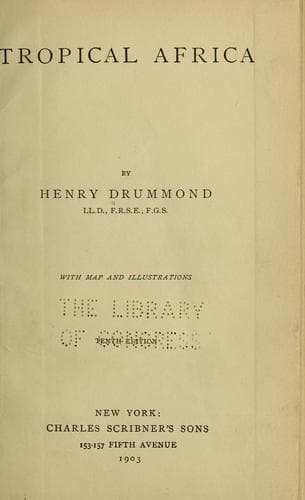
Africa, Central -- Description and travel; Africa, East -- Description and travel; Natural history -- Africa; Slave trade
Next afternoon our little vessel left the Zambesi in its wake and
struck up a fine lake-like expansion to the north, which represents
the mouth of the Shiré. Narrower and deeper, the tributary is a
better stream for navigation than the Zambesi. The scenery also is
really fine, especially as one nears the mountains of the plateau,
and the strange peoples and animals along the banks occupy the mind
with perpetual interests. The hippopotami, prowling round the boat
and tromboning at us within pistol-shot, kept us awake at night; and
during the day we could see elephants, buffaloes, deer, and other
large game wandering about the banks. To see the elephant at home is
a sight to remember. The stupendous awkwardness of the menagerie
animal, as if so large a creature were quite a mistake, vanishes
completely when you watch him in his native haunts. Here he is as
nimble as a kitten, and you see how perfectly this moving mountain is
adapted to its habitat--how such a ponderous monster, indeed, is as
natural to these colossal grasses as a rabbit to an English park. We
were extremely fortunate in seeing elephants at all at this stage,
and I question whether there is any other part of Africa where these
animals may be observed leisurely and in safety within six weeks of
London. Mr. Stanley in his Livingstone expedition was ten months in
the country before he saw any; and Mr. Joseph Thomson, during his
long journey to Tanganyika and back, never came across a single
elephant. It is said that the whale which all travellers see in
crossing the Atlantic is kept up by the steamboat companies, but I
vouch that these Shiré valley elephants are independent of subsidy.
Public-domain text, read in full here on John Shaqi.
Reviews
Reviews
No reviews yet
Be the first to share your thoughts on this work.
Join the Discussion
Join the discussion
Sign in to leave a comment or review.
Sign InorCreate an account