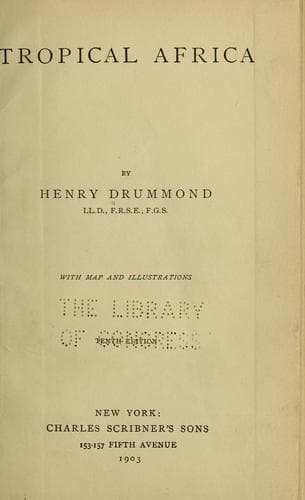
Africa, Central -- Description and travel; Africa, East -- Description and travel; Natural history -- Africa; Slave trade
_29th September_.--Left Karongas, at the north end of Lake Nyassa, at
10.30, with a mongrel retinue of seven Mandalla natives, twelve
Bandawé Atongas, six Chingus, and my three faithfuls--Jingo, Moolu,
and Seyid. Total twenty-eight. Not one of my men could speak a word
of English. They belonged to three different tribes and spoke as
many languages; the majority, however, knew something of Chinanja,
the lake language, of which I had also learned a little, so we soon
understood one another. It is always a wise arrangement to have
different tribes in a caravan, for in the event of a strike, and
there are always strikes, there is less chance of concerted action.
Each man carried on his head a portion of my purse--which in this
region consists solely of cloth and beads; while one or two of the
more dependable were honored with the transportation of the tent,
collecting-boxes, provisions, and guns.
The road struck into a banana grove, then through a flat country
fairly well wooded with a variety of trees, including many palms and
a few baobabs. The native huts dotted over this rich flat are the
best I have seen in Africa. The roofs are trimly thatched, and a
rude carving adorns door-post and lintel. After seven miles the
Rukuru is crossed--a fine stream rippling over the sand, with large
flakes of mica tumbling about in the current, and sampling the rocks
of the distant hills. The men laid down their loads, and sprawled
about like crocodiles in the water as I waded across. A few yards
off is a village, where a fire was quickly lit, and the entire
population turned out to watch the white man nibble his lunch. The
consumption at this meal being somewhat slight, and the menu strange
to my audience, I saw that they regarded the white man's effort at
nutrition with feelings of contempt. "The M'sungu eats nothing,"
whispered one, "he must die." The head man presently came asking
beads; but, as I had none unpacked, two stray trinkets and a spoonful
of salt more than satisfied him. On getting the salt he deftly
twisted a leaf into a little bag, and after pouring all the salt into
it, graciously held out his hand to a troop of small boys who crowded
round, and received one lick each of his empty palm. Salt is perhaps
the greatest luxury and the greatest rarity the north-end African can
have, and the avidity with which these young rascals received their
homœopathic allowance proved the instinctiveness of the want. I
have often offered native boys the choice between a pinch of salt and
a knot of sugar, and they never failed to choose the first. For
return-present the chief made over to me two large gourds filled with
curds, of which, of course, I pretended to drink deeply before
passing it on to the men.
Public-domain text, read in full here on John Shaqi.
Reviews
Reviews
No reviews yet
Be the first to share your thoughts on this work.
Join the Discussion
Join the discussion
Sign in to leave a comment or review.
Sign InorCreate an account