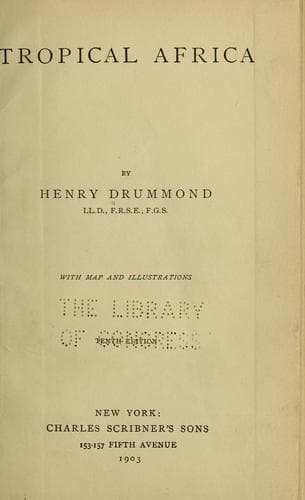
Africa, Central -- Description and travel; Africa, East -- Description and travel; Natural history -- Africa; Slave trade
Three miles of the same country, with tall bean-plants about, castor
oil, and maize, but no villages in sight. Bananas unusually fine,
and Borassus everywhere. At the tenth or eleventh mile we reached
the fringe of hills bordering the higher lands, and, taking advantage
of a passage about half a mile wide which has been cut by the river,
penetrated the first barrier--a low rounded hill of conglomerate,
fine in texture, and of a dark-red-color. Flanking this for two
miles, we entered a broad oval expansion among the hills, the site
apparently of a former lake. Winding along with the river for a mile
or two more, and passing through a narrow and romantic glen, we
emerged in a second valley, and camped for the night on the banks of
the stream. On the opposite side stood a few native huts, and the
occupants, after much reconnoitring, were induced to exchange some
_ufa_ and sweet potatoes for a little cloth.
_1st October_.--Moolu peered into my tent with the streak of dawn to
announce a catastrophe. Four of the men had run away during the
night. All was going so well yesterday that I flattered myself I was
to be spared this traditional experience--the most exasperating of
all the traveller's woes, for the whole march must be delayed until
fresh recruits are enlisted to carry the deserters' loads. The
delinquents were all Bandawé men. They had no complaint. They stole
nothing. It was a simple case of want of pluck. They were going
into a strange land. The rainy season was coming on. Their loads
were full-weight. So they got homesick and ran. I had three more
Bandawé men in the caravan, and, knowing well that the moment they
heard the news they would go and do likewise, I ordered them to be
told what had happened and then sent to my tent. In a few moments
they appeared; but what to say to them? Their dialect was quite
strange to me, and yet I felt I must impress them somehow. Like the
judge putting on the black cap, I drew my revolver from under my
pillow, and, laying it before me, proceeded to address them.
Beginning with a few general remarks on the weather, I first briefly
sketched the geology of Africa, and then broke into an impassioned
defence of the British Constitution. The three miserable
sinners--they had done nothing in the world--quaked like aspens. I
then followed up my advantage by intoning in a voice of awful
solemnity, the enunciation of the Forty-Seventh Proposition of
Euclid, and then threw my all into a blood-curdling _Quod erat
demonstrandum_. Scene two followed when I was alone; I turned on my
pillow and wept for shame. It was a prodigious piece of rascality,
but I cannot imagine anything else that would have done, and it
succeeded perfectly. These men were to the end the most faithful I
had. They felt thenceforth they owed me their lives; for, according
to African custom, the sins of their fellow-tribesmen should have
been visited upon them with the penalty of death.
Public-domain text, read in full here on John Shaqi.
Reviews
Reviews
No reviews yet
Be the first to share your thoughts on this work.
Join the Discussion
Join the discussion
Sign in to leave a comment or review.
Sign InorCreate an account