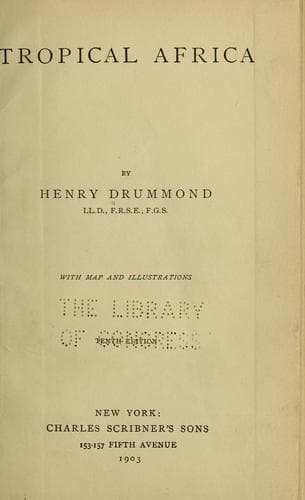
Africa, Central -- Description and travel; Africa, East -- Description and travel; Natural history -- Africa; Slave trade
The dreadful part of the day was the interval. Then
observations were made, and specimens collected and arranged, each
man having to fill a collecting-box before sunset. When this was
over there was nothing else to do that it was not too hot to do. It
was too hot to sleep, there was nothing to read, and no one to speak
to; the nearest post-office was a thousand miles off, and the only
amusement was to entertain the native chiefs, who used occasionally
to come with their followers to stare at the white man. These
interviews at first entertained one vastly, but the humbling
performances I had to go through became most intolerable. Think of
having to stand up before a gaping crowd of savages and gravely
button your coat--they had never seen a coat; or, wonder of wonders,
strike a match, or snap a revolver, or set fire to somebody's bark
clothes with a burning-glass. Three or four times a day often I had
to go through these miserable performances, and I have come home with
a new sympathy for sword-swallowers, fire-eaters, the man with the
iron jaw, and all that ilk.
The interview commenced usually with the approach of two or three
terror-stricken slaves, sent by the chief as a preliminary to test
whether or not the white man would eat them. Their presents, native
grains of some kind, being accepted, they concluded I was at least
partly vegetarian, and the great man with his courtiers, armed with
long spears, would advance and kneel down in a circle. A little
speechifying followed, and then my return presents were produced--two
or three yards of twopence-halfpenny calico; and if he was a very
great chief an empty Liebig pot or an old jam tin was also presented
with great ceremony. None of my instruments, I found, at all
interested these people--they were quite beyond them; and I soon
found that in my whole outfit there were not half a dozen things
which conveyed any meaning to them whatever. They did not know
enough even to be amazed. The greatest wonder of all perhaps was the
burning-glass. They had never seen glass before, and thought it was
_mazi_ or water, but why the _mazi_ did not run over when I put it in
my pocket passed all understanding. When the light focused on the
dry grass and set it ablaze their terror knew no bounds. "He is a
mighty spirit!" they cried, "and brings down fire from the sun."
This single remark contains the key to the whole secret of a white
man's influence and power over all uncivilized tribes. Why a white
man, alone and unprotected, can wander among these savage people
without any risk from murder or robbery is a mystery at home. But it
is his moral power, his education, his civilization. To the African
the white man is a supreme being. His commonest acts are miracles;
his clothes, his guns, his cooking utensils are supernatural.
Everywhere his word is law. He can prevent death and war if he but
speak the word. And let a single European settle, with fifty square
Public-domain text, read in full here on John Shaqi.
Reviews
Reviews
No reviews yet
Be the first to share your thoughts on this work.
Join the Discussion
Join the discussion
Sign in to leave a comment or review.
Sign InorCreate an account