The art of tunneling entered its last and greatest phase with the
construction of the Mont Cenis tunnel in Europe and the Hoosac tunnel in
America, which works established the utility of machine rock-drills and
high explosives. The Mont Cenis tunnel was built to facilitate railway
communication between Italy and France, or more properly between
Piedmont and Savoy, the two parts of the kingdom of Victor Emmanuel II.,
separated by the Alps. It is 7.6 miles long, and passes under the Col di
Fréjus near Mont Cenis. Sommeiller, Grattoni, and Grandis were the
engineers of this great undertaking, which was begun in 1857, and
finished in 1872. It was from the close study of the various
difficulties, the great length of the tunnel, and the desire of the
engineers to finish it quickly, that all the different improvements were
developed which marked this work as a notable step in the advance of the
art of tunneling. Thus the first power-drill ever used in tunnel work
was devised by Sommeiller. In addition, compressed air as a motive power
for drills, aspirators to suck the foul air from the excavation, air
compressors, turbines, etc., found at Mont Cenis their first application
to tunnel construction. This important rôle played by the Mont Cenis
tunnel in Europe in introducing modern methods had its counterpart in
America in the Hoosac tunnel completed in 1875. In this work there were
used for the first time in America power rock-drills, air compressors,
nitro-glycerine, electricity for firing blasts, etc.
There remains now to be noted only the final development in the art of
soft-ground submarine tunneling, namely, the use of the shield and metal
lining. The shield was invented and first used by Sir Isambard Brunel in
excavating the tunnel under the River Thames at London, which was begun
in 1825, and finished in 1841. In 1869 Peter William Barlow used an iron
lining in connection with a shield in driving the second tunnel under
the Thames at London. From these inventions has grown up one of the most
notable systems of tunneling now practiced, which is commonly known as
the shield system.
In closing this brief review of the development of modern methods of
tunneling, to the presentation of which the remainder of this book is
devoted, mention should be made of a form of motive power which promises
many opportunities for development in tunnel construction. Electricity
has long been employed for blasting and illuminating purposes in tunnel
work. It remains to be extended to other uses. For hauling and for
operating certain classes of hoisting and excavating machinery it is one
of the most convenient forms of power available to the engineer. Its
successful application to rock-drills is another promising field. For
operating ventilating fans it promises unusual usefulness.
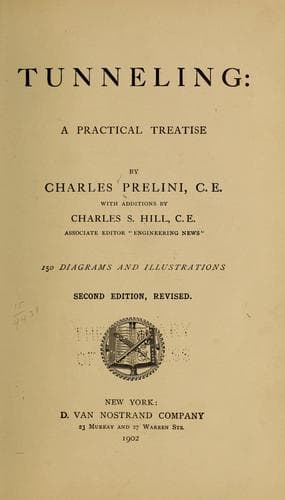
TUNNELING
CHAPTER I.
PRELIMINARY CONSIDERATIONS. CHOICE BETWEEN A TUNNEL AND OPEN CUT.
GEOLOGICAL SURVEYS.
CHOICE BETWEEN A TUNNEL AND AN OPEN CUT.
Public-domain text, read in full here on John Shaqi.
Reviews
Reviews
No reviews yet
Be the first to share your thoughts on this work.
Join the Discussion
Join the discussion
Sign in to leave a comment or review.
Sign InorCreate an account