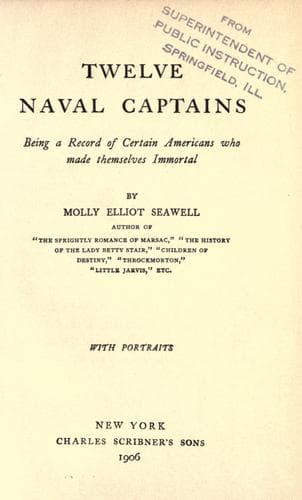
Twelve Naval Captains: Being a Record of Certain Americans Who Made Themselves ImmortalSeawell, Molly Elliot
History
Twelve Naval Captains: Being a Record of Certain Americans Who Made Themselves Immortal
Seawell, Molly Elliot
United States. Navy -- Biography
Commodore Barron took about half an hour to deliberate before sending
a reply; and as soon as the British boat put off, orders were given
to clear the ship for action and get the people to quarters, and
Commodore Barron himself went on deck. While this was being done, the
Leopard hailed, and fired a gun toward the Chesapeake, followed by
a whole broadside, and for about twelve minutes she poured her fire
into the helpless Chesapeake. Commodore Barron, a marine officer, and
sixteen men were wounded, and three men were killed. Commodore Barron
repeatedly ordered a shot to be fired before the ensign was lowered,
but there were no means at hand for igniting the powder. At last a
young lieutenant named Allen ran to the galley, and, taking a live coal
in his fingers, rushed back to the gun-deck and succeeded in firing one
of the guns in his division. At that moment the American ensign touched
the taffrail.
The Leopard then sent a boat and took possession of the three alleged
deserters, and made off, while the disgraced Chesapeake returned to
Norfolk.
It is not easy to describe the outburst of indignation which followed
this mortifying event. Commodore Barron was court-martialled, but
as it was proved that his mistake was one of judgment, and that he
conducted himself well after the danger became imminent, he was merely
sentenced to five years' suspension from the navy.
The British government disavowed the action of Captain Humphries of
the Leopard, although it did not punish him; but Vice-Admiral Berkley
was never again employed in the British navy. It also restored the
three men it had taken from the Chesapeake to the deck of the American
frigate.
After this affair it began to be plain that the United States must
either boldly repulse the efforts of Great Britain in her claims to
right of search, or else tamely submit. The latter was not to be
thought of. The war of 1812 was fought for the principle of protecting
sailors in American ships, and for the right to carry goods in free
bottoms; hence its motto was: "Free trade and sailors' rights."
These were agitating times for the navy, as officers of intelligence
realized that war was coming and it would be chiefly a naval war;
and they therefore strove diligently to perfect themselves in their
profession, so that when they came in conflict with the seasoned
sailors of England the American navy might give a good account of
itself.
Lawrence was among the most earnest and ambitious of these young
officers, and he acquitted himself so well in those intervening years
that it was plain he would do well in whatever situation he was placed.
In 1808 he was made first lieutenant of the Constitution, and that was
the last subordinate place he held. In 1809 he got the Vixen, which
he exchanged for the Wasp, and finally the Argus. In 1811 he got the
Hornet, a fast and beautiful little cruiser, carrying eighteen guns,
and was in command of her when the long-expected declaration of war
came in 1812.
Public-domain text, read in full here on John Shaqi.
Reviews
Reviews
No reviews yet
Be the first to share your thoughts on this work.
Elsewhere in the archive
Join the Discussion
Join the discussion
Sign in to leave a comment or review.
Sign InorCreate an account