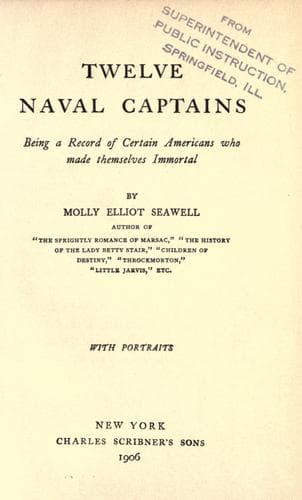
Twelve Naval Captains: Being a Record of Certain Americans Who Made Themselves ImmortalSeawell, Molly Elliot
History
Twelve Naval Captains: Being a Record of Certain Americans Who Made Themselves Immortal
Seawell, Molly Elliot
United States. Navy -- Biography
The Pallas, under Captain Cottineau, had captured the Countess of
Scarborough, which made a brave defence, and, in company with the
Serapis, sailed for the port of the Texel, which they reached in
safety. England scarcely felt the loss of one frigate and a sloop from
her tremendous fleets, but the wound to the pride of a great and noble
nation was severe. She caused the Dutch government to insist that
Paul Jones should immediately leave the Texel. This he refused to do,
as it was a neutral port, and he had a right to remain a reasonable
time. The Dutch government then threatened to drive him out, and had
thirteen double-decked frigates to enforce this threat, while twelve
English ships cruised outside waiting for him. But Paul Jones kept his
flag flying in the face of these twenty-five hostile ships, and firmly
refused to leave until he was ready. Through some complication with the
French government, he had the alternative forced upon him of hoisting a
French flag on the Serapis, or taking the inferior Alliance under the
American flag. Bitter as it was to give up the splendid Serapis, he
nobly preferred the weaker ship, under the American flag, and in the
Alliance, in the midst of a roaring gale on a black December night, he
escaped from the Texel, "with my best American ensign flying," as he
wrote Dr. Franklin.
The British government offered ten thousand guineas for him, dead or
alive, and forty-two British ships of the line and frigates scoured
the seas for him. Yet he escaped from them all, passed within sight of
the fleets at Spithead, ran through the English Channel, and reached
France in safety. He went to Paris, where he was praised, admired,
petted by the court, and especially honored by royalty. The King,
Louis XVI., gave him a magnificent sword, while the Queen, the lovely
and unfortunate Marie Antoinette, invited him in her box at the opera,
and treated him with charming affability. The first time he went to the
theatre in Paris, he found a laurel wreath suspended over his seat.
He rose quietly and moved away,--an act of modesty which was much
applauded by all.
Captain Pearson, on his return to England, received honors that caused
many persons to smile, although he had undoubtedly defended his ship
very determinedly. He was made a knight. When Paul Jones heard of this,
he remarked: "Well, he has deserved it; and if I have the good fortune
to fall in with him again, I will make him a lord."
Compliments were plenty for Paul Jones, too; but no ship was
forthcoming for him worthy of his fame, and at last, in 1780, he was
forced to return to America in the Ariel, a lightly armed vessel,
carrying stores for Washington's army.
Public-domain text, read in full here on John Shaqi.
Reviews
Reviews
No reviews yet
Be the first to share your thoughts on this work.
Join the Discussion
Join the discussion
Sign in to leave a comment or review.
Sign InorCreate an account