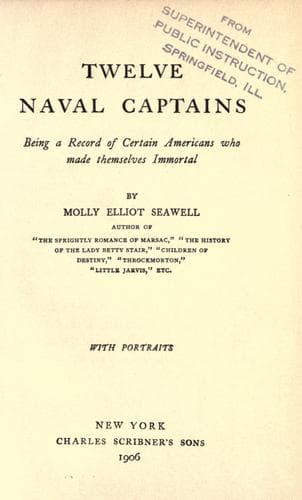
Twelve Naval Captains: Being a Record of Certain Americans Who Made Themselves ImmortalSeawell, Molly Elliot
History
Twelve Naval Captains: Being a Record of Certain Americans Who Made Themselves Immortal
Seawell, Molly Elliot
United States. Navy -- Biography
His services were fully appreciated in the United States. General
Washington wrote him a letter of congratulation; Congress passed a
resolution of thanks in his honor, and gave him a gold medal; and the
French king made him a Knight of the Order of Military Merit. The
poverty of his country prevented him from getting a ship immediately,
and the virtual end of the war in 1781 gave him no further opportunity
of naval distinction.
He was employed in serving the naval interests of the country on this
side of the ocean until 1787, when he went to Europe on a mission for
the government. While there, he had brilliant offers made him to enter
the service of the Empress Catherine of Russia, and to take charge of
naval operations against the Turks. The nature of Paul Jones was such
that any enterprise of adventurous daring was irresistibly attractive
to him. At that time his firm friend Thomas Jefferson was minister to
France, and he advised Paul Jones to accept the offer. This he did,
relying, as he said, on Mr. Jefferson to justify him in so doing, and
retaining his American citizenship. He had an adventurous journey to
Russia, stopping for a while on public business at Copenhagen, where he
was much caressed by the King, Queen, and Court. He resumed his route
by sea, and at one time in a small boat in the Baltic Sea he forced the
sailors to proceed at the point of his pistol, when their hearts failed
them and they wished to turn back.
His connection with the Russian navy proved deeply unfortunate. He had
to deal with persons of small sense of honor, who cared little for
the principles of generous and civilized warfare. He was maligned and
abused, and although he succeeded in clearing himself, he left Russia
with disappointment and disgust. His health had begun to fail, and the
last two years of his life, from 1790 to 1792, were spent in Paris,
where he was often ill, and more often in great distress of mind over
the terrible scenes then occurring in France. He did not forget that
the King and Queen had been his friends, and showed them attentions
when it was extremely dangerous to do so. Lafayette, who had long been
his devoted friend, soothed his last days; and Gouverneur Morris, then
minister to France, paid him many kind attentions. He made his will,
naming Robert Morris as his executor, and then faced death with the
same cool courage as upon the bloody and burning deck of the Bon Homme
Richard.
In the evening of the 18th of July, 1792, after calmly making his
preparation, the end came. The National Assembly of France paid honor
to his remains, and in the United States the news of his death was
received with profound sorrow. Some years after, the Congress sent the
St. Lawrence frigate to Europe, to bring back the body of Paul Jones
to the United States; but it was found that, according to the French
custom, it had been destroyed by quicklime long before.
Public-domain text, read in full here on John Shaqi.
Reviews
Reviews
No reviews yet
Be the first to share your thoughts on this work.
Join the Discussion
Join the discussion
Sign in to leave a comment or review.
Sign InorCreate an account