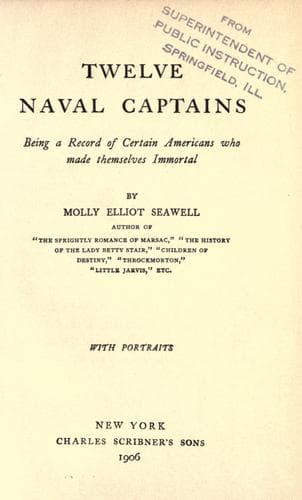
Twelve Naval Captains: Being a Record of Certain Americans Who Made Themselves ImmortalSeawell, Molly Elliot
History
Twelve Naval Captains: Being a Record of Certain Americans Who Made Themselves Immortal
Seawell, Molly Elliot
United States. Navy -- Biography
As soon as the Americans had possession of the Serapis, Dale sat down
on the binnacle, overcome with exhaustion, after nearly ten hours of
manoeuvring and fighting, two hours of the time the ships having been
lashed together. He gave an order, and, rising to see it executed,
measured his length on the deck. Then for the first time he knew that
he was wounded. He managed to keep the deck, however, and his wound
proved to be trifling.
In all the accounts of the compliments showered upon Paul Jones and his
officers at the Texel and afterward at Paris, Dale seems to have kept
modestly in the background. His worth, however, was not overlooked,
and his testimony that Captain Landais of the Alliance had acted
treacherously toward the Bon Homme Richard during the fight with the
Serapis was of weight in securing Landais' dishonorable discharge from
the continental navy.
While Paul Jones was enjoying the charms and splendors of Paris, Dale,
who had little taste for such things, was "keeping ship" so well that
the captain's absence was not felt. Like Paul Jones, he ardently longed
to put to sea in a fine ship; but both were doomed to disappointment
when the Ariel was the best to be had. In her he sailed, with Paul
Jones, for America, in 1781. Off the French coast they met with a storm
so terrific that Dale always declared he considered they were in more
danger than at any time during the fight with the Serapis. In speaking
of Paul Jones's coolness in such desperate straits, when every moment
they seemed about to go to the bottom, Dale said: "Never saw I such
coolness in such dreadful circumstances as I saw in Paul Jones then."
To the amazement of all, they escaped with their lives, although the
Ariel was so crippled that they had to return to port, and it was many
weeks before they could sail again.
On reaching America, Paul Jones desired Dale to accompany him to
Portsmouth, New Hampshire, where the government directed him to
superintend the building of a fine frigate then on the stocks. But
Dale preferred active service, and joined the Trumbull frigate, going
through with his usual experience, a hot fight with a British ship and
a severe wound. This time he varied the performance by being captured
for the fifth time. He was soon exchanged, however, and the war ended
shortly after.
The navy of the United States ceased practically to exist at the close
of the Revolution, and Dale went into the China trade. He made a modest
fortune, came ashore, and married a beautiful girl, the ward of his old
commander Captain Barry. In 1794 the navy was reorganized, and Dale was
the first captain who got afloat under the United States flag. He made
several cruises, and in 1801 was made commodore of a fine squadron sent
to the Mediterranean. His flagship was the President, and it was a sad
coincidence that upon this very ship, in the war of 1812, his son, a
gallant young midshipman, received his death wound.
Public-domain text, read in full here on John Shaqi.
Reviews
Reviews
No reviews yet
Be the first to share your thoughts on this work.
Join the Discussion
Join the discussion
Sign in to leave a comment or review.
Sign InorCreate an account