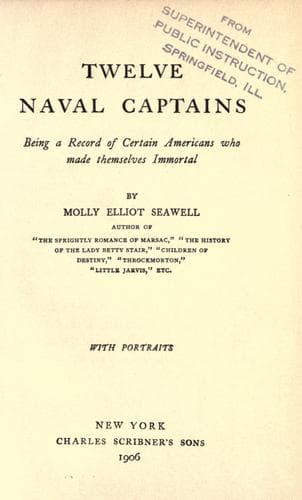
Twelve Naval Captains: Being a Record of Certain Americans Who Made Themselves ImmortalSeawell, Molly Elliot
History
Twelve Naval Captains: Being a Record of Certain Americans Who Made Themselves Immortal
Seawell, Molly Elliot
United States. Navy -- Biography
The fine appearance of the American ships and the smartness of their
officers and crews were generally admired, and Dale himself made
friends and admirers by his manly and modest bearing. He spelled no
better than ever, but his seamanship was beyond reproach. Once, on
coming out of Port Mahon, the President struck upon a rock, and was in
imminent danger of pounding herself to death. Commodore Dale was below
when she struck. He instantly came on deck, assumed command, and by his
coolness, nerve, and judgment, saved the ship. He had her temporarily
repaired, under his own directions, at Port Mahon, but went to Toulon
to have her put in dry dock. When the water was pumped out, and her
hull exposed, the French naval officers were lost in admiration at the
ingenious way in which, with crude appliances and materials, Dale had
contrived to repair the damage.
The great Nelson, while observing the manoeuvring of this fine
squadron under Commodore Dale, remarked: "Those American ships can, if
they wish, make trouble for the British navy."
Dale returned home, expecting to spend the rest of his active life in
the navy. But in those days it seems to have been a common practice to
treat the most distinguished and deserving officers without the least
consideration of their rights or feelings. This happened to Commodore
Dale. An affront being offered him by the head of the navy, he promptly
resigned. He had two gallant sons who remained in the navy, however;
and one of these, his namesake, lost his life while gallantly fighting
in the war of 1812. Dale retired to Philadelphia, and spent the rest
of his days in honorable retirement. His old friend Captain Barry had
come into possession of the splendid gold sword given Paul Jones by the
King of France, and which Paul Jones's relatives had given to Robert
Morris, and from him Captain Barry got it. On Captain Barry's death he
left this sword, most worthily and appropriately, to Dale, the great
captain's first lieutenant.
Public-domain text, read in full here on John Shaqi.
Reviews
Reviews
No reviews yet
Be the first to share your thoughts on this work.
Join the Discussion
Join the discussion
Sign in to leave a comment or review.
Sign InorCreate an account