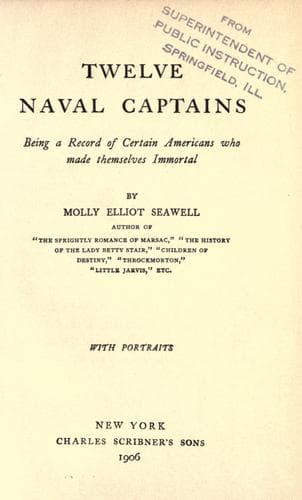
Twelve Naval Captains: Being a Record of Certain Americans Who Made Themselves ImmortalSeawell, Molly Elliot
History
Twelve Naval Captains: Being a Record of Certain Americans Who Made Themselves Immortal
Seawell, Molly Elliot
United States. Navy -- Biography
Bainbridge remained in command of merchant ships until the
reorganization of the navy in 1798. During those years a singular and
unsatisfactory state of affairs existed for American ships on the
ocean. Without a single ship of war to protect them, they were liable
to be overhauled by British warships, which claimed the right to
search, by French warships, which practically fought and captured them,
while a large trade with the North of Europe and the East was harassed
by the corsairs of the Barbary coast. With regard to these last, a
truly disgraceful condition prevailed. The Dey of Algiers actually
demanded and received tribute from the United States government for not
molesting its trading-vessels! It is true that other nations of Europe
submitted to the same sort of blackmail; but their reasons, although
not sufficient, were better than those of the Americans. New in the art
of forming a great republic, and unduly fearful of the dangers of a
fixed naval force as well as of a standing army, the government of the
United States tried to do without a navy; but it paid for its mistake
many times over, both in national honor and in money. The European
nations also paid money to the Barbary pirates, and allowed their ships
to be used in various ways, at the request of these haughty despots;
but it was with a desire to secure their political alliances in the
universal wars that scourged Europe at that day, and not from inability
to protect their own carrying ships.
It may be imagined how galling this was to American captains, and that
they resisted whenever there was a chance of success. Young Bainbridge
was the last man to submit to coercion when he could help himself, and
on two occasions, while in command of merchant vessels, showed the
spirit that was in him. Once, when commanding the Hope, a little vessel
carrying only eleven men before the mast and four nine-pounders, he
fell in with a British privateer, carrying thirty men and eight guns. A
sharp action ensued; for privateers are not wont to heed any vessel's
rights when the privateer is the stronger party, and Paul Jones's
characterization of them as "licensed robbers" is not far wrong. The
Hope, however, made a good defence, and forced the privateer to call
for quarter. Under the existing law, Bainbridge could not claim her
as lawful prize, but was forced to let her go, shouting out to her
commander as they parted, "Tell your employers if they have occasion
for the Hope, they must send some other man than you to get her!"
Public-domain text, read in full here on John Shaqi.
Reviews
Reviews
No reviews yet
Be the first to share your thoughts on this work.
Join the Discussion
Join the discussion
Sign in to leave a comment or review.
Sign InorCreate an account