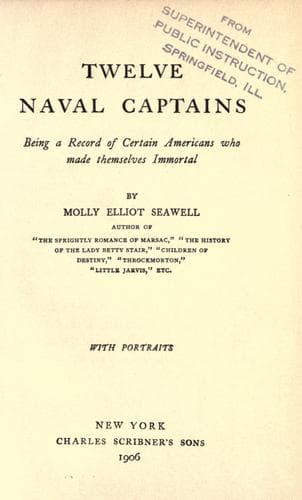
Twelve Naval Captains: Being a Record of Certain Americans Who Made Themselves ImmortalSeawell, Molly Elliot
History
Twelve Naval Captains: Being a Record of Certain Americans Who Made Themselves Immortal
Seawell, Molly Elliot
United States. Navy -- Biography
The Bashaw, only half believing, allowed Bainbridge to go, and on
the 1st of June, 1805, nineteen months exactly after his capture,
Bainbridge again trod the deck of an American man-of-war. Commodore
Rodgers, commanding the Constitution, and all the officers of the
squadron received him affectionately. They had brought out a treaty
of peace for the Bashaw to sign, and the first stipulation was that
every American prisoner should be given up immediately and without
conditions. This, Bainbridge said, he did not believe the Bashaw would
ever agree to, as it was a fixed principle with the Barbary powers
never to give up a prisoner without ransom. Bainbridge returned to
the shore at nightfall, and, with Sidi, went to the castle, where
the Bashaw expressed great surprise at seeing him again. The Bashaw,
however, was far less inclined to keep up the fight than Bainbridge
imagined. After a day or two of hesitation, a council of war was held
at which Bainbridge was invited to be present,--an honor never before
bestowed upon a prisoner of the Barbary States. When Bainbridge entered
the council chamber at the castle, he found the Bashaw surrounded
by all of his great officers of state, with the treaty brought by
Commodore Rodgers spread out before them. To sign it meant peace, and
the immediate release of every American prisoner; to refuse it meant
that the Constitution and her consorts lying out within gunshot of the
town, would be thundering at their forts and ships within an hour.
The question of peace or war was debated with grave eloquence. The
council was evenly divided. At last the decision had to be made. The
Bashaw, after a solemn pause, took his signet ring from his bosom, and,
affixing it to the treaty, said with dignity,--
"It is peace."
Bainbridge is said to have thought, after the event happened, that the
Bashaw had no real intention of withstanding another bombardment, and
his hesitation and final yielding to the advocates of peace was a
preconcerted arrangement.
As soon as the treaty was signed, the forts and castle saluted the
American flag, and the squadron returned the salute. Next day the
American prisoners were released. A Neapolitan who had been held in
slavery for years by the Tripolitans had been very kind to the sailors
and marines, and they asked Bainbridge if he would authorize the purser
to advance them seven hundred dollars out of their pay to buy the
Neapolitan's freedom. This was done, and the man was restored to his
country by these grateful men.
The squadron sailed for Syracuse, where a court of inquiry into the
loss of the Philadelphia was held, and Bainbridge was honorably
acquitted. On his return to the United States he was received with
much kindness by his companions in arms, by the government, and the
people, all of whom regarded him as a brave and capable officer who had
lost his ship by one of those fateful accidents against which neither
courage nor capacity can prevail.
Public-domain text, read in full here on John Shaqi.
Reviews
Reviews
No reviews yet
Be the first to share your thoughts on this work.
Join the Discussion
Join the discussion
Sign in to leave a comment or review.
Sign InorCreate an account