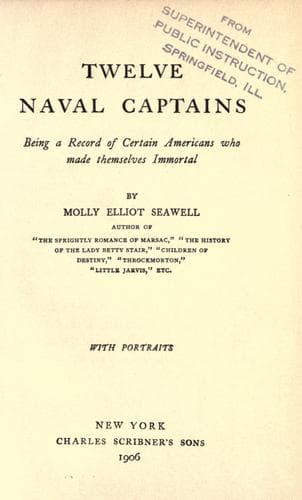
Twelve Naval Captains: Being a Record of Certain Americans Who Made Themselves ImmortalSeawell, Molly Elliot
History
Twelve Naval Captains: Being a Record of Certain Americans Who Made Themselves Immortal
Seawell, Molly Elliot
United States. Navy -- Biography
It seems singular that on the heels of the splendid successes of the
navy before Tripoli and with the rest of the Barbary powers, the
government and the people showed very little understanding of the
value of the naval service. As soon as hostilities were over with
the corsairs, a reduction of the navy took place, although at that
very time aggressions of Great Britain upon American merchant ships
were continuing at a rate which was bound to provoke war in the end.
Bainbridge, like many others, found himself without a ship, and on
half-pay; and he asked and obtained leave, during the intervals when he
was without a naval command, to make voyages in the merchant service.
He was absent on one of these voyages for profit in the autumn of 1811,
when at St. Petersburg he heard of the probability of a declaration
of war with Great Britain. He started instantly on his return to the
United States, and reached Washington in February, 1812. He found there
one of Commodore Preble's captains, Charles Stewart,[3] and to his
rage and mortification was told that the government thought it vain
and foolhardy to give battle on the sea to the mightiest naval power
on earth, which had then vanquished the navies of Europe and kept them
skulking in their own harbors. Such over-prudence ill suited the ardent
and determined natures of Bainbridge and Stewart. They heard that
the government had concluded to lay up such ships as it had, and to
prosecute the fight entirely on land. They went together to President
Madison, and besought him to change this cowardly and unwise policy,
and succeeded in persuading him to do it. For this one act the country
is forever indebted to Bainbridge and Stewart. While nothing could
eventually stop the progress of the United States toward being a great
and powerful nation, yet, had it not been for the victories gained at
sea during the War of 1812-15, the dignity and prestige of the United
States would have suffered an eclipse for fifty years. The success of
the Americans in the ship duels on the ocean during the war of 1812
did more to make the United States respected abroad than any event of
our history after the Revolution. The great question of the right of
search in neutral vessels was settled by the achievements of a few
smart vessels with great and daring captains, belonging to a young
and hitherto feeble power in America,--a right which had been vainly
contested by all the powers of Europe. The British navy had been for
more than a hundred years practically invincible, and there can be no
doubt that many of its earlier losses in 1812-15 came from absolute
rashness, fostered by a long and glorious career of conquest. What was
of more value to the United States than the respect of continental
Europe was the respect earned from the English themselves. The United
States of 1812 was chiefly populated by those only a few generations
from an English ancestry, and the people of the two countries were
Public-domain text, read in full here on John Shaqi.
Reviews
Reviews
No reviews yet
Be the first to share your thoughts on this work.
Join the Discussion
Join the discussion
Sign in to leave a comment or review.
Sign InorCreate an account