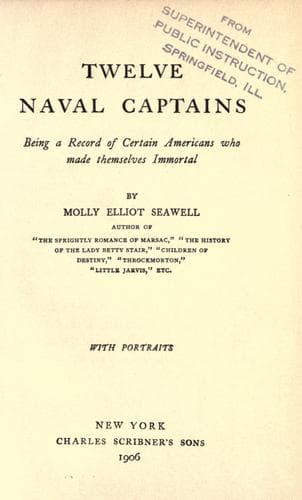
Twelve Naval Captains: Being a Record of Certain Americans Who Made Themselves ImmortalSeawell, Molly Elliot
History
Twelve Naval Captains: Being a Record of Certain Americans Who Made Themselves Immortal
Seawell, Molly Elliot
United States. Navy -- Biography
alike in their willingness to make a square, stand-up fight, and then
to shake hands afterward. From the hour that the first British frigate
struck to an American ship, the British navy highly esteemed the
American navy, and the British government realized that at last there
was a sea power equal in skill, daring, and resource to Great Britain.
The ships lost by the British were scarcely missed from their huge
fleets; but Great Britain, like America, promptly recognized the new
and tremendous force which the taking of those few ships implied. It
was one of the most fortunate hours that ever dawned for the United
States when the advice of Bainbridge and Stewart was taken, and within
six months they were amply justified.
Bainbridge by his rank was entitled to a choice of the few frigates the
country then owned, and he would undoubtedly have chosen the glorious
"Old Ironsides" upon which to hoist his flag. But Hull[4] had got
her already, and, apprehending that orders might come detaching him,
he put to sea in a hurry, and before he returned, had captured the
Guerrière frigate. Bainbridge got the Constellation, the fine frigate
in which Commodore Truxtun had fought two French frigates. He was not
able, however, to get to sea in her; and when Hull returned from his
victorious cruise, in August, 1812, he gave up the Constitution to
Bainbridge, who hoisted a broad pennant on her. The Essex, thirty-two
guns, commanded by Captain Porter, who afterward made his celebrated
cruise in her to the Pacific, and the Hornet, of eighteen guns, under
the gallant Lawrence,[5] with the Constitution, were ordered to join
Bainbridge. Porter was Bainbridge's old lieutenant in the Philadelphia,
and had shared his captivity at Tripoli. Events, however, so fell
out that the Essex did not join the other two ships, and Bainbridge
sailed in October, 1812, for the South Atlantic accompanied only by
the Hornet. The Constitution was in need of repairs, and not sailing
in her usual great form, but could still sail fairly well on a wind.
She had some of the officers and all of the crew in her that had got
her out of the clutches of Admiral Broke's squadron in June, and had
taken the Guerrière in August. Therefore it was with great confidence
that Commodore Bainbridge on the morning of the 29th of December,
1812, made for a British frigate which showed an equal inclination to
close with him. This vessel, the Java, which carried forty-nine guns,
was undoubtedly a lighter ship than the Constitution. Yet the British
were in the habit of engaging such odds successfully with the warships
of other nations, and Captain Lambert of the Java showed a stern
determination to stand by his colors, and was as far from declining the
fight when he saw his adversary's power as when she was still hull down
in the distance.
Public-domain text, read in full here on John Shaqi.
Reviews
Reviews
No reviews yet
Be the first to share your thoughts on this work.
Join the Discussion
Join the discussion
Sign in to leave a comment or review.
Sign InorCreate an account