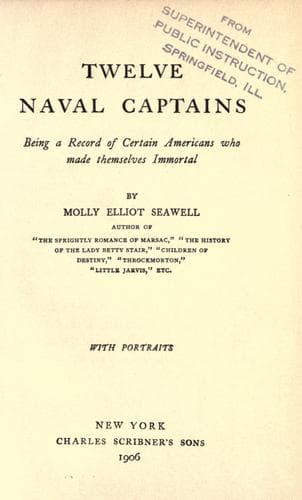
Twelve Naval Captains: Being a Record of Certain Americans Who Made Themselves ImmortalSeawell, Molly Elliot
History
Twelve Naval Captains: Being a Record of Certain Americans Who Made Themselves Immortal
Seawell, Molly Elliot
United States. Navy -- Biography
When the United States was laid up in ordinary, Stewart was given the
command of a small schooner, the Experiment. In this little vessel he
showed much spirit and enterprise, making many captures, and fighting
whenever he had a chance.
Stewart was, like Decatur, of an impetuous and even domineering
disposition, and made everybody under him "walk Spanish," as the
sailors said. But he himself knew how to obey promptly. Once, having
received a peremptory order from his superior officer to report with
his ship immediately, Stewart sailed, towing his mainmast after him, as
he had not time to have it fitted and did not choose to wait.
In 1803 he was sent to the Mediterranean with the Siren, a beautiful
little cruiser, as a part of Commodore Preble's squadron destined to
reduce Tripoli. Stewart was the senior among the commodore's "schoolboy
captains," and second in command to Commodore Preble himself.
Although he had no opportunity of performing deeds like Decatur's
in the Tripolitan war, his general good conduct was highly praised,
and the Siren was brilliantly engaged in all the glorious actions of
that famous time. At the beginning of the war of 1812 Stewart was
given the command of the Constellation, frigate, which shared with
the Constitution the reputation of being a lucky ship,--lucky in
meeting and whipping her enemies when the force was anything like
equal, and lucky in running away when they were too many for her.
Stewart took command of this noble ship at Annapolis in 1813. He was
ordered to Norfolk, and took the ship to Hampton Roads. He arrived
and anchored one night, and next morning at daylight there were five
British men-of-war in sight of him. The Constellation endeavored to
get out of the way, and the British ships chased her, but, the wind
failing, both the pursuers and the pursued were becalmed. Stewart,
though, remembering the Constitution's escape by kedging from a British
squadron, concluded it would never do that the Constellation should not
succeed equally as well; so, putting out his boats, the frigate was
kedged up toward Norfolk, until the tide fell, and she took the ground
at Seawell's Point, not far from the present Fort Monroe. The mud was
soft, the ship's bottom was hard, and the tide would rise; so Stewart
felt no alarm about her. The British squadron were also waiting for
the tide, but they did not think that Stewart would attempt to get his
ship up the narrow and tortuous channel to Norfolk.
Public-domain text, read in full here on John Shaqi.
Reviews
Reviews
No reviews yet
Be the first to share your thoughts on this work.
Elsewhere in the archive
Join the Discussion
Join the discussion
Sign in to leave a comment or review.
Sign InorCreate an account