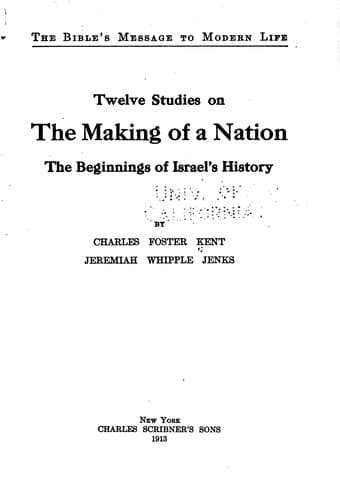
Twelve Studies on the Making of a Nation: The Beginnings of Israel's History — John Shaqi
Twelve Studies on the Making of a Nation: The Beginnings of Israel's HistoryKent, Charles Foster
Religion
Twelve Studies on the Making of a Nation: The Beginnings of Israel's History
Kent, Charles Foster
Jews -- History
When I consider thy heavens, the work of thy fingers,
The moon and the stars which thou hast ordained;
What is man, that thou art mindful of him?
And the son of man that thou visitest him?
For thou hast made him but little lower than God,
And crownest him with glory and honor.
Thou makest him to have dominion over the works of thine hands,
Thou hast put all things under his feet.--_Ps. 8: 8-6_.
God clothed men with strength like his own,
And made them according to his own image.
He put the fear of them upon all flesh,
That they should have dominion over beasts and birds.
Mouth and tongue, eyes and ears,
And a mind with which to think he gave them;
With insight and wisdom he filled their minds,
Good and evil he taught them. Ben Sira. 17, 3-7 (_Hist. Bible_).
All things were made through him; and without him was not any thing
made that hath been made.--John 1:3.
I.
DIFFERENT THEORIES OF CREATION.
Every early people naturally asked the questions, How were things
made? How were men created? First of all, Who made the world?
They necessarily answered them according to their own dawning
knowledge.
The most primitive races believed that some great animal created
the earth and man. In the Alaskan collection in the museum of the
University of Pennsylvania there is a huge crow, sitting upon the
mask of a man's face. This symbolizes the crude belief of the
Alaskan Indians regarding the way man was created. The early
Egyptians thought that the earth and man were hatched out of an
egg. In one part of Egypt it was held that the artisan god Ptah
broke the egg with his hammer. In another part of the land and
probably at a later date the tradition was current that Thoth the
moon god spoke the world into existence. The earliest Babylonian
record states that:
The god Marduk laid a reed on the face of the waters,
He formed dust and poured it out beside the reed;
That he might cause the gods to dwell in the dwellings
of their heart's desire,
He formed mankind.
Later he formed the grass and the rush of the marsh and the forest.
Then he created the animals and their young.
The Parsee teachers held that the rival gods, Ahriman and Ormuzd,
evolved themselves out of primordial matter and then through the
long ages created their attendant hierarchies of angels. The
philosophers of India anticipated in some respects our modern
evolutionary theory. Brahma is thought of as self-existent and
eternal. He gradually condenses himself into material objects,
such as ether, fire, water, earth and the elements. Last of all he
manifests himself in man. The Greek philosophers were the first to
attempt to describe creation as a purely physical, generative
process. They taught the evolution of the more complex from the
simpler forms. Plato and Aristotle believed in a transcendental
deity and found in the world indications of a vital impulse toward
a higher manifestation of life--man.
Public-domain text, read in full here on John Shaqi.
Reviews
Reviews
No reviews yet
Be the first to share your thoughts on this work.
Join the Discussion
Join the discussion
Sign in to leave a comment or review.
Sign InorCreate an account