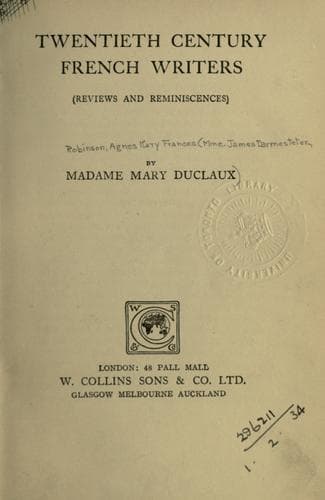
Twentieth Century French Writers: Reviews and ReminiscencesRobinson, A. Mary F. (Agnes Mary Frances)
History
Twentieth Century French Writers: Reviews and Reminiscences
Robinson, A. Mary F. (Agnes Mary Frances)
French literature -- 20th century -- History and criticism
_L’Enfer_, M. Barbusse’s first great success, is a really bad book!
a far worse book, I think, than _Pot-bouille_, with which it invites
comparison. Zola showed us an ordinary Paris mansion, or system of
‘flats,’ and, taking off the roof Asmodeus-wise, revealed on every
floor the iniquities it contained, and by so doing the novelist sought
to demonstrate the corruption of society in its actual form. His
earnestness to some extent redeemed his foulness. And the same holds
good of Barbusse. But how miserable is his treatment of the theme.
He imagines a respectable boarding-house a kind of Maison Vauquer of
a less dilapidated sort. The narrator is one of the boarders. In his
wall, a cleft or crevice in a panel puts his bedroom into unsuspected
communication with the chamber on the other side. He looks and listens;
and what goes on under his spyhole is the unsavoury theme of the volume
tersely called: Hell. Debauch, despair, adultery, death, birth; at
one moment the consultation of two doctors on a case of cancer; at
another, the vigil beside a corpse; such are the things discovered by
the peephole of an undreamed-of witness. They are described with a
luxury of nastiness which suggests some medical student afflicted with
erotomania. He spies upon lust; he prys into the last spasms of pain;
his mind is unbalanced. And we imagine him saying to himself, ‘Oh,
I’ll make your flesh creep and your blood run cold!’ When he leaves
description for theory, he is an Anarchist. Above all, he is a cad.
(We are speaking, of course, of the fictitious narrator, and not of M.
Henri Barbusse.) But we must admit that he is a gifted and sensitive
cad. That is why, although we devote the book to the flames, we read it
first....
We have heard how Gautama, brought up until adolescence amid the false
enchantments of a sequestered palace, one day crossed the threshold and
met, ere he had taken twenty steps, a corpse, a leper, and an old man
bent double and blind in his decrepitude: Death--Disease--Old Age--and
was told it was the common lot. Whereupon Gautama forsook the world and
henceforth his conversation was in Heaven.
M. Barbusse also has met the three spectres, and with them their
attendant spirits, Lust and Cruelty. But pity has turned in his heart,
not to prayer, but to a passionate anger, a violent reaction against
civilisation as it stands. On every page of this first book he shouts
‘Follow your instincts! Eat, drink, and make merry, for to-morrow you
die!’ And _sotto voce_ he seems to add: ‘Destroy! lest ye be destroyed!’
The popularity of Barbusse is therefore a disquieting symptom, but
all his novels are not as outrageous as _L’Enfer_. In _Le Feu_ he
discovered a theme exactly suited to his genius. _Le Feu_ is perhaps
the only war book which really gives a living image of the war. It is
unique and unforgettable. _L’Enfer_, as I have said, is a bad book; but
_Le Feu_, with all its faults, is a masterpiece.
Public-domain text, read in full here on John Shaqi.
Reviews
Reviews
No reviews yet
Be the first to share your thoughts on this work.
Elsewhere in the archive
Join the Discussion
Join the discussion
Sign in to leave a comment or review.
Sign InorCreate an account