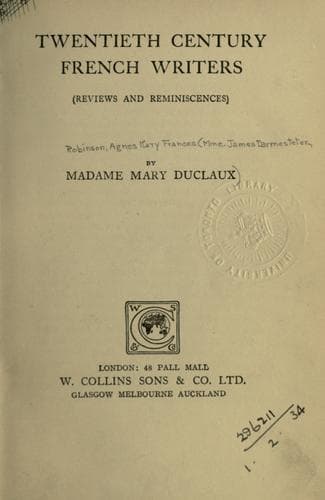
Twentieth Century French Writers: Reviews and ReminiscencesRobinson, A. Mary F. (Agnes Mary Frances)
History
Twentieth Century French Writers: Reviews and Reminiscences
Robinson, A. Mary F. (Agnes Mary Frances)
French literature -- 20th century -- History and criticism
Since then Nolly had learned the words that save. He was, I think, no
ardent Catholic, like Psichari or Péguy; but his faith in the destinies
of human society, his conviction that the army of France is indeed a
Salvation Army, not only for Frenchmen, but for his dear Senegalese,
for black, red, and yellow--every shade of skin or soul--gave him the
persuasiveness of the men of Napoleon’s army. And he went out into the
highways and the by-ways and compelled them to come in.
And now these young men--so much younger than I, who sit by my lonely
fire and remember them--these young men with a future, as it seemed,
are all dead for their country and for the faith that was in them.
Their bodies lie in wayside tombs, or in the middle of the fields,
with a rough cross over them, and a name traced in ink that the autumn
rains efface. And that name, which was beginning to shine in the
literary record of their nation, that name which they looked to burnish
in the course of the next thirty years, can now receive no further
lustre. From the personal, individualist point of view, their fame is
sacrificed, even as their lives are sacrificed. They are mulcted in
their works, as in their race, for, among them all, only Péguy was a
father. And, so far as they knew, their immense suffering and sacrifice
was in vain. They lie, perhaps, among those dreadful heaps which the
shell at once agglomerates and scatters, and from which all individual
difference is wiped out. So many of them!
The saddest fate of all, I think, was Émile Nolly’s--to die so slowly
and so painfully of his wounds, in hospital, while the fight in which
he longed to join was raging, still undecided.
HENRI BARBUSSE
Before the war, the name of Henri Barbusse was practically unknown.
And now he is, of all French writers, the most widely read: he is
the Prince of Best-sellers. Bourget has his tens of thousands, his
scores of thousands; but _Le Feu_ is in its 250th thousand, _L’Enfer_
in its 200th thousand, and _Clarté_ (published in January, 1919) had
reached its fortieth thousand by the beginning of March. And all these
novels have appeared in war time, despite the endless difficulties of
book-production.
What is the reason of this prodigious success? How is it that
Barbusse, who was an unknown young poet in 1913, should satisfy to-day
the souls of so vast a public. One may say that he has inherited the
immense unsatisfied public left desolate since the death of Zola.
He has most of Zola’s qualities, imagination; a tragic realism that
impresses an image lastingly on the reader’s brain; and a sort of
public passion, rather than public spirit, that makes him feel other
men’s grievances and wrongs more keenly than his own. Moreover, he
has all Zola’s faults--and they are of a kind that do not prejudice
the sale of a book--he has Zola’s filth, his sexual obsession; Zola’s
anarchism, and his Utopias; Zola’s abuse of horror in the evocation of
physical torture.
Public-domain text, read in full here on John Shaqi.
Reviews
Reviews
No reviews yet
Be the first to share your thoughts on this work.
Elsewhere in the archive
Join the Discussion
Join the discussion
Sign in to leave a comment or review.
Sign InorCreate an account