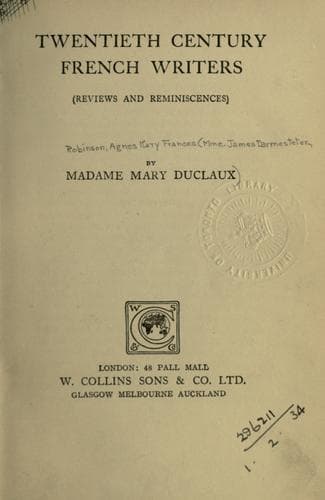
Twentieth Century French Writers: Reviews and ReminiscencesRobinson, A. Mary F. (Agnes Mary Frances)
History
Twentieth Century French Writers: Reviews and Reminiscences
Robinson, A. Mary F. (Agnes Mary Frances)
French literature -- 20th century -- History and criticism
It is the journal of a squad--fifteen or a dozen common soldiers in
the trenches; their infinite pettiness, their infinite grandeur; the
horrors they succumb to or surmount. The first page shows the strange
moats or living wells of the trenches--and the strange creatures (huge
bears, no doubt) who growl and waddle and stumble therein--‘des espèces
d’ours qui pataugent et grognent. C’est nous.’
The book is a series of episodes rather than a novel. Strange
how this form--which the French call the ‘Chest-of-Drawers,’ the
_roman-à-tiroirs_, comprising a set of independent though sequestered
events contained in a solid framework--has taken possession of French
literature. M. Duhamel also employs it. _Jean-Christophe_ was a
_roman-à-tiroirs_. Most popular during the Middle Ages and Renaissance
(both the Divine Comedy and Don Quixote are on this model), the
Nineteenth Century preferred the firm organic contexture of the novel
of character. _La Cousine Bette_ or _Madame Bovary_, _The Mill on the
Floss_, _Vanity Fair_, _The Old Curiosity Shop_, appeared to us of the
Nineteenth Century, a finer development, an evolution. But the world
goes round!
Some of these episodes, once read, are fixed in the memory for ever;
and of these the finest, I think, is _Le Portique_. Who can forget
the death of Poterloo in the explosion of the obus, as he rises from
the earth, bolt upright, black, his two arms stretched full length as
on a cross, and a flame on his shoulders in place of the shattered
head? We cannot banish that terrible image if we would. There are
pages of _Le Feu_, which, just glanced at, imprint themselves on our
consciousness--like the death of the horse, Trompette, in the mine of
_Germinal_, for we are always brought back to our initial comparison
of M. Barbusse with Zola. And those who appreciate what I can but call
the epic grandeur of _Germinal_ or _L’Assommoir_, will do well to read
_Le Feu_; while those who cannot endure the foul images, the filthy
realism, the coarse slang, the half-mad enthusiasms and indignations of
Zola, will be wise in avoiding any book by Henri Barbusse.
For M. Barbusse, like Zola, is an apostle and writes inspired by the
energy of his social revolt. Like Péguy--although he is so different
from Péguy--he longs to fly to the rescue. There was a medieval saint
and poetess, Mechtild of Magdeburg, who sang in one of her lyric
prayers, ‘Ô Christ on the Cross, lend me Thine arms to save a suffering
world!’ That is the prayer of M. Barbusse, only he addresses it to
Socialism--or rather, if I understand him aright, to Bolshevism. He
would save the dumb dwellers in that dark underworld which, in the
present state of things, appears to have no issue. ‘And he went down
into Hell.’ More than once the line has slid into my mind in reading
his unedifying pages, and I understood that here, too, was a sort of
Gospel--the most modern of the apocrypha.
Public-domain text, read in full here on John Shaqi.
Reviews
Reviews
No reviews yet
Be the first to share your thoughts on this work.
Elsewhere in the archive
Join the Discussion
Join the discussion
Sign in to leave a comment or review.
Sign InorCreate an account