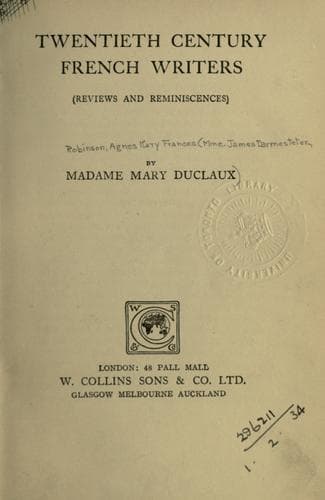
Twentieth Century French Writers: Reviews and ReminiscencesRobinson, A. Mary F. (Agnes Mary Frances)
History
Twentieth Century French Writers: Reviews and Reminiscences
Robinson, A. Mary F. (Agnes Mary Frances)
French literature -- 20th century -- History and criticism
One may doubt of the wisdom of a social theory which, seeing the stain
on our vesture, would simply turn it wrong side out. The stain may go
right through. The world may prove no stronger and no saner if you
set it upside down. I am not M. Barbusse’s political convert. But I
admire him for his reaction, his revolt against that which most of us
so readily accept--the sufferings of the unknown mass. It is well that
there should be writers who rouse and reveal, though their trumpet
notes be harsh and unmodulated--well there should be those who shake
the sleepers from their sloth and bid them save their neighbours and
themselves, building anew, lest the pillars of the temple fall and
crush us all in their ruin.
In _Clarté_ the ideas of M. Barbusse are explained at full length:
abolition of inheritance, universal disarmament, universal equality,
universal Republic in the Federation of the World. In this book (which
concerns the life of a clerk in the office of a factory, who marries,
goes to the war, and returns to look at his wife and society, with not
unkindly but disenchanted eyes)--M. Barbusse has lost his coarseness,
but also that biting acid which imprinted on our remembrance the scenes
of _Le Feu_. In his feminine characters--in the old aunt, in Marie, the
wife, in the little blind girl whom every one pities and for whom no
one cares--he shows a new quality of tenderness.
What will he give us to-morrow?
GEORGES DUHAMEL
Like Henri Barbusse, M. Georges Duhamel has found his great opportunity
in the events of the war. Before 1914 we knew him as a young writer of
promise in only too many directions. He had written a play, _À l’Ombre
de Statues_, which Antoine produced at the Odéon Theatre, and which
was (with Marie Lenéru’s _Affranchis_) the chief success of Antoine’s
heroic voyage of discovery in the perilous tracts of unknown youthful
genius. M. Duhamel was also just coming into notice as a poet and
especially as a critic of poetry in the columns of the _Mercure de
France_. We liked his young uncompromising voice and the deliberate
way in which he said that he was proud to be born in the century
which produced a Paul Claudel. He had as yet published no novel. But
the mobilisation revealed his capacity as a doctor, and it was as an
army-surgeon that he joined the forces.
Public-domain text, read in full here on John Shaqi.
Reviews
Reviews
No reviews yet
Be the first to share your thoughts on this work.
Elsewhere in the archive
Join the Discussion
Join the discussion
Sign in to leave a comment or review.
Sign InorCreate an account