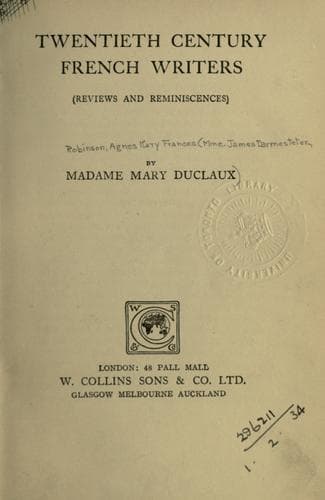
Twentieth Century French Writers: Reviews and ReminiscencesRobinson, A. Mary F. (Agnes Mary Frances)
History
Twentieth Century French Writers: Reviews and Reminiscences
Robinson, A. Mary F. (Agnes Mary Frances)
French literature -- 20th century -- History and criticism
His _Vie des Martyrs_ (which Mr Heinemann has published in English
as the _New Book of Martyrs_) revealed a considerable writer, with
that rare gift of insight, of recognition, which pierces at a glance
to the core of things. Tenderness, infinite pity, regret, a sense of
the helplessness of science, a sense of the hopelessness of so-called
progress which ends in such an explosion of organised disorder--it is
these feelings that inspire the good physician as he bends above the
murdered youths, the martyrs, whom it is his destiny always to torture
and sometimes to cure or to relieve. _La Vie des Martyrs_ is a set of
brief sketches of the lives and deaths of wounded soldiers in hospital
on the front.
With a brief, sure touch (which comes, I think, from his familiarity
with the writing of verse), M. Duhamel indicates the few essential
outlines which bring into living relief the poor lads to whom he
ministers: the Zouave who thought himself so strong when his spine
was touched with paralysis; Léglise, of whom his country claimed the
double sacrifice of his two legs and who yet found life worth living;
Boucheutore--but why enumerate the cases? It is not the cases that
matter, it is the souls that animate these tortured and shattered
bodies, which M. Duhamel knows how to make, as it were, transparent to
our gaze. There is in these studies (as there was in the eyes of Béal)
‘une lumière, une douceur une tristesse extrêmes.’ We have heard of the
religion of human suffering--and here it wells from a deep and loving
nature, full of spiritual richness, and yet totally devoid of mysticism
or piety.
I like _La Vie des Martyrs_ better than _Civilisation_ which followed
it in 1918 and was awarded the Prix Goncourt last December. This
latter book inclines to the theories of M. Barbusse: Oh, Civilisation,
what crimes are committed in thy name! The setting is the same; the
personages are still the wounded soldiers, but also the M.O.’s and
great visiting Surgeons, sanitary inspectors, and in these latter
sketches M. Duhamel reveals an admirable talent for caricature. There
is something of Daumier’s biting wit in his portraits of medical
‘big-wigs.’
Here is a writer with great gifts, a master of tears and laughter. His
sketches are admirable. But has he the gift of organic construction?
Will he (as the draughtsman Boz became the painter Dickens) go on from
strength to strength?
Time will show.
THE COUNTESS DE NOAILLES
Public-domain text, read in full here on John Shaqi.
Reviews
Reviews
No reviews yet
Be the first to share your thoughts on this work.
Elsewhere in the archive
Join the Discussion
Join the discussion
Sign in to leave a comment or review.
Sign InorCreate an account