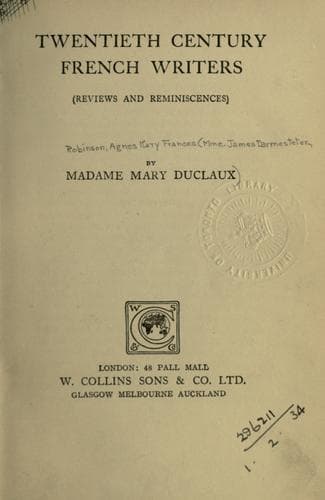
Twentieth Century French Writers: Reviews and ReminiscencesRobinson, A. Mary F. (Agnes Mary Frances)
History
Twentieth Century French Writers: Reviews and Reminiscences
Robinson, A. Mary F. (Agnes Mary Frances)
French literature -- 20th century -- History and criticism
Years and years ago--five-and-twenty years ago--I used sometimes to
spend my Thursday afternoons with a Russian friend; more than once on
these occasions our pleasure was heightened by the musical talent of
her little cousins, the young daughters of the Princess Brancovan.
In my mind’s eye I still see the two children seated on the long
piano-stool; I contemplate their fervent shoulders, their four thick
dark plaits, bobbing from side to side, and the small eager right
hand of one, and the left hand of her sister, flying up and down
the keyboard as they interpret, four-handed, some difficult page of
Beethoven.
My friend died; years passed; I saw no more of the young musicians.
They grew up; they married. And then one day, in 1901, a new book of
poems burst--yes, literally _burst_--upon the world of letters; and
I learnt with pleasure and curiosity that its author, the Countess
Mathieu de Noailles, was the Princess Anna de Brancovan. Like all
Paris, I read her poems.
Have you ever seen, in Switzerland or in Auvergne (in some mountain
country), the spring meadows, at Eastertime, when the young foals, the
lambs, and especially the little calves (born in the dusk of the stable
in February) make their first irruption into a world of sunshine, of
tender and fresh green grass stretching illimitably in all directions?
If not, and if you would none the less realise the extreme of joy, of
young delight in mere existence, take down from the shelf _Le Cœur
Innombrable_, or indeed any of the early poems of Madame de Noailles.
Madame de Noailles resembles no living poet or poetess. There is none
among them who gives us so absolutely the sense of inspiration--the
poet’s frenzy with its flights and its fervours--and also the flagging,
drifting laxness of the verse when suddenly that inspiration fail. Yet,
even in that wandering delirium, we feel (as in the diviner poetry
of Shelley) no less than the poet’s weakness, the strength and the
ardour of the afflatus. On the frontispiece of her second book (_Les
Éblouissements_, 1907), Mme de Noailles has inscribed a sentence from
Plato’s _Banquet_: ‘My heart beats more tumultuously than the pulse of
the priests of Cybele.’ And indeed the dance, the extravagant fury, the
κoρυβαντιασμός, of the Phrygian festival are echoed in the strophes
of this daughter of Hellas, married into the house of Noailles. But
the young Mænad (strayed from Parnassus into France) is never more to
my liking than when suddenly she interrupts her corybantic song to
idle in her walled fruit-garden, making friends with her pears and
apples, praising the brave, bright splashes of red on the ranks of her
scarlet-runners, or counting the gathered peaches ranged among straw on
the shelves of the fragrant fruitery, while a wasp whizzes out his soul
of rage against the dusty window-pane:--
Public-domain text, read in full here on John Shaqi.
Reviews
Reviews
No reviews yet
Be the first to share your thoughts on this work.
Elsewhere in the archive
Join the Discussion
Join the discussion
Sign in to leave a comment or review.
Sign InorCreate an account