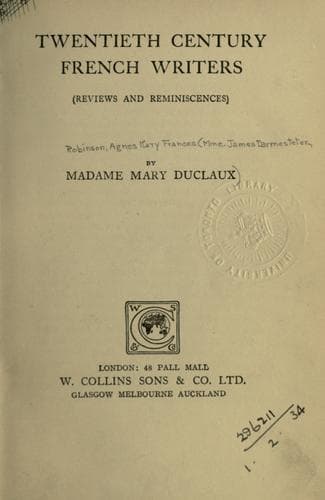
Twentieth Century French Writers: Reviews and ReminiscencesRobinson, A. Mary F. (Agnes Mary Frances)
History
Twentieth Century French Writers: Reviews and Reminiscences
Robinson, A. Mary F. (Agnes Mary Frances)
French literature -- 20th century -- History and criticism
‘Ô peuple parfumé des fruits,
Vous que le chaud été compose
De cieux bleus et de terre rose,
Vous, sève dense, sucre mol,
Nés des jeux de l’air et du sol,
Vous qui vivez dans une crèche,
Petits dieux de la paille fraîche,
Compagnons de l’arrosoir vert.
Des hottes, des bêches, de fer,
Gardez-moi dans la douce ronde
Que forme votre odeur profonde!’
There is in Madame de Noailles something of Pindar--and something of
Herrick. I like her best in Herrick’s vein, singing the homely things
we know with a penetrating, new, and yet familiar sweetness:--
‘Bien plus que pour Bagdad dont le seul nom étonne,
Que pour Constantinople, ineffable Houri,
Je m’émeus quand je vois dans un matin d’automne
Le clocher de Corbeil ou de Château-Thierry.’
But that other self of hers--the Phrygian pythoness--is no less worthy
of our attention. Every page of this volume bears the imprint of her
image, ardent, wasted, joyous, excited, full of a mingled asperity
and sweetness. Her voice rings out intoxicated with the wonder of the
universe, the mystery of life, the terror of death. None of the poets
of our generation has expressed so keenly the mortal pang caused by the
impact of a beauty which is eternal on a system of nerves which is the
cobweb of an hour:--
‘Je n’ai fait résonner que mes nerfs sur ma lyre.’
It is true there is little of deep emotion and little of pure thought
in these earlier poems of Madame de Noailles; but all that the sense
can receive of the outer world is exquisitely rendered. So alive is the
poetess to the magic and glory of the visible world that she is jealous
of that inner, personal realm which engrosses us so much. Constantly
she regrets those years of childhood, which were objective, calm, free
from the tumult of the heart:--
‘Enfants, regardez bien toutes les plaines rondes,
La capucine avec ses abeilles autour,
Regardez bien l’étang, les champs, avant l’amour;--
Car après l’on ne voit plus jamais rien du monde.
‘Après l’on ne voit plus que son cœur devant soi,
On ne voit plus qu’un peu de flamme sur sa route,
On n’entend rien, on ne sait rien, et l’on écoute
Les pieds du triste Amour qui court ou qui s’assoit.’
But passion is not the only power which contends with our faculty for
absorbing the imperishable quality of the Cosmos. There is another, yet
more terrible, which splits the glass in our hands, even as we raise it
to our lips:--
‘Ô beauté de toute la terre,
Visage innombrable des jours,
Voyez avec quel sombre amour
Mon cœur en vous se désaltère.
‘Et pourtant il faudra nous en aller d’ici
Quitter les jours luisants, les jardins où noussommes,
Cesser d’être du sang, des yeux, des mains, des hommes,
Descendre dans la nuit avec un front noirci.
Public-domain text, read in full here on John Shaqi.
Reviews
Reviews
No reviews yet
Be the first to share your thoughts on this work.
Elsewhere in the archive
Join the Discussion
Join the discussion
Sign in to leave a comment or review.
Sign InorCreate an account