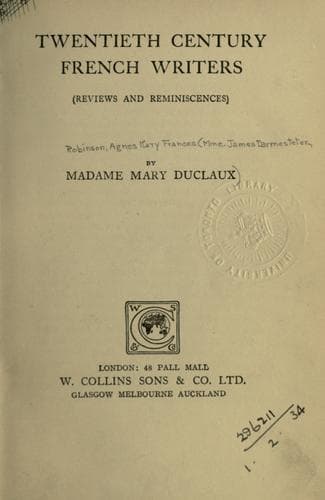
Twentieth Century French Writers: Reviews and ReminiscencesRobinson, A. Mary F. (Agnes Mary Frances)
History
Twentieth Century French Writers: Reviews and Reminiscences
Robinson, A. Mary F. (Agnes Mary Frances)
French literature -- 20th century -- History and criticism
‘Descendre par l’étroite, l’horizontale porte,
Où l’on passe étendu, voilé, silencieux;
Ne plus jamais vous voir, Ô Lumière des cieux!
Hélas! je n’étais pas faite pour être morte.’
These verses, and many others no less beautiful--for one of the
characteristics of Madame de Noailles is her abundance--could leave no
doubt on my mind of the quality of the poetess, and I remember writing,
when her second book appeared:--
‘There are four lyric poets--there are at least four lyric
poets--writing to-day in France. If we glance over the land in a sort
of bird’s eye view, we see, down by the river, like a faun in the
reeds and rushes, M. Francis Jammes piping on his Pan’s pipe a sweet
irregular and broken music. His is an elfin spirit, familiar with green
things and shy wild animal life; his patrons are St Francis and Ariel.
Where the bee sucks, there lurks he; and yet he is not wholly natural.
Something quaint, furtive, and precious in his style reminds us of a
constant artifice in his simplicity.
‘Let us now lift our gaze towards the busier haunts of men; there, in
an inspired attitude, stands M. Fernand Gregh, his hand lifted towards
the visionary lyre of Victor Hugo, which, like the dagger of Macbeth,
hovers before him, just out of reach; yet, though he never wholly
grasps it, sometimes the poet snatches a fine strain of music from the
strings. A little higher, among the ruins of antiquity, meditates in
music M. Henri de Régnier. But who is this who rushes past (her eye in
a fine frenzy rolling), singing in an incoherent passion of delight,
like the wild shepherdess--_La Ravie de l’Amour de Dieu_--in the Queen
of Navarre’s delightful pastoral, soaring sunwards in a corybantic
ecstasy--who is this lyric muse, half siren and half bird?
“And all a wonder and a wild desire.”’
(In those days I had not read the odes of M. Paul Claudel. And, after
all, can one call a poet ‘lyric,’ if he choose to write his rhapsodies
in prose?)
A year or two later, our poetess gave us, one after the other, three
books in prose--a strange beautiful Oriental prose, charged with
colour as the draperies of a Russian ballet, full of a crude barbarian
charm. First she produced (I think her best prose book) _La Nouvelle
Espérance_.
Public-domain text, read in full here on John Shaqi.
Reviews
Reviews
No reviews yet
Be the first to share your thoughts on this work.
Elsewhere in the archive
Join the Discussion
Join the discussion
Sign in to leave a comment or review.
Sign InorCreate an account