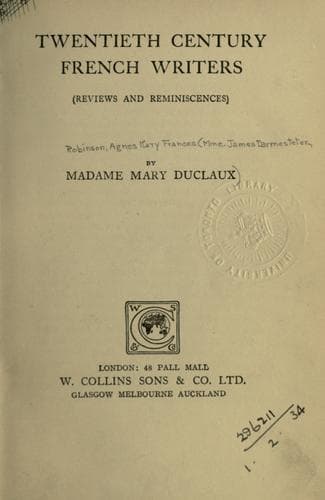
Twentieth Century French Writers: Reviews and ReminiscencesRobinson, A. Mary F. (Agnes Mary Frances)
History
Twentieth Century French Writers: Reviews and Reminiscences
Robinson, A. Mary F. (Agnes Mary Frances)
French literature -- 20th century -- History and criticism
The novels of Madame de Noailles all tell more or less the same story.
They show us a woman of passionate and eager temperament, a soul of
suffering ardour, fevered with a sort of avid languor, of fierce
tenderness whose cold fit is a sudden revolt of indifference or pride:
a woman who reminds us sometimes of Mademoiselle de Lespinasse and
sometimes of Phædra! Need we say that this self-centred and sensual
being is unhappy? Yet she is full of poetry, of passion, of charm, half
a spoiled child, half an inspired Muse. But she seeks in sentiment
and in sensation an Absolute which does not exist on earth. Thus,
imprisoned in the tyrannous circle of her own personality, she turns
round upon herself, like a squirrel in its cage. So at least we see her
in this first novel and in the last: _La Domination_.
Between the two the poetess has placed a sort of pastel, a sort of
fairy-tale, exquisite in its refinement and impossible grace, _Le
Visage Emerveillé_, where, if the features are the same, the colour and
the lighting are so softened that we greet with a smile what, in the
other volumes seemed, in all cruel sincerity, the terrible image of
hysterical passion.
And then, in the summer of 1913, she produced, after so long a silence
of the Muse, her finest poems. Ah! here she is her real self--she
whom Melchior de Voguë used to call, briefly, emphatically, ‘le grand
poète,’ distinguishing her thus among her contemporaries. The Countess
de Noailles is really a great poet--the greatest that the Twentieth
Century has as yet produced in France, perhaps in Europe. In her the
romantic Nineteenth Century has its last echo: her ardent magnificence,
her sense of the wild beauty of natural things, her lyric cries, her
vast horizons magically evoked, her summits and her tempests, and then
her sudden bursts of simple, friendly homeliness, recall the genius of
Victor Hugo.
_Photo: Dormac_ _To face p. 184_
[Illustration: =The Countess de Noailles=]
But in this new volume the Bacchante, the Undine, of her earlier
poems comes back to us in tears. Like Prince Gautama when he left
his palace, she has encountered love and sickness and death. She has
learned that to live is to suffer; she has discovered that man (and
especially woman) has a heart to feel, as well as eyes to see with;
that our destiny is always mysterious and generally sad. This is
no longer the vine-crowned Bacchante, irresponsible as a young and
graceful tiger-cub, whose sole desire was to satisfy her instinct. This
is not she who, in her tamer moments, tuned her flute in the sunny
kitchen-garden under the warm south wall, hung with espaliers, smiling
as she sang: ‘Yon ripe pear is my heart!’
Public-domain text, read in full here on John Shaqi.
Reviews
Reviews
No reviews yet
Be the first to share your thoughts on this work.
Elsewhere in the archive
Join the Discussion
Join the discussion
Sign in to leave a comment or review.
Sign InorCreate an account