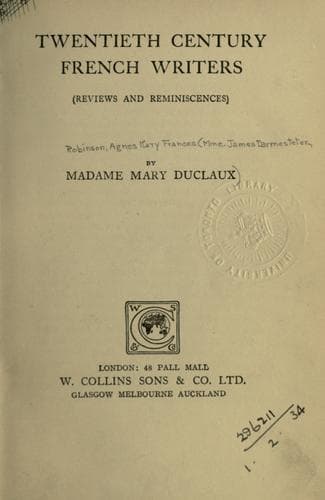
Twentieth Century French Writers: Reviews and ReminiscencesRobinson, A. Mary F. (Agnes Mary Frances)
History
Twentieth Century French Writers: Reviews and Reminiscences
Robinson, A. Mary F. (Agnes Mary Frances)
French literature -- 20th century -- History and criticism
EPILOGUE 257
MAURICE BARRÈS
I
Maurice Barrès is the oldest of all the personages of this little
book, which deals emphatically with the young--with the writers of the
Twentieth Century, and not with those already famous fifteen years ago.
Still, every rule has its exceptions; and it is impossible to imagine
the young literature of our days without this man of fifty. Time flies,
and never did it seem to me to fly more swiftly than in this moment,
when I realise that Barrès must be ranked among the middle-aged. Only
the other day, he was that young Deputy, delightfully impertinent,
impatient of the ways of his elders, who rose from his bench in the
Chamber to propose ‘that the ashes of Jules Simon be transferred to
the Panthéon’--Jules Simon being at that moment comfortably seated in
the Upper House. May it be long before the ashes of Maurice Barrès are
carried to the home of the immortals!
Yet Time has already begun his travesties: the Don Juan of letters,
the _enfant terrible_ of politics, is already a sort of Conscript
Father, almost a Father of the Church. He, too, in the world of
letters, dignifies the Upper House, for he is an Academician. Maurice
Barrès is the Chateaubriand of our unfolding age, or, to translate my
meaning into English, he is perhaps even more exactly its Disraeli--a
Disraeli reversed: an incomparable artist, a brilliant politician, but,
in this latter line, something of an amateur. Still we cannot imagine
our Barrès stripped of his politics, nor even the literature of our
time without the politics of Barrès. His Nationalism, his Regionalism
fill and flood the literature of France as fully as Imperialism
occupied the English horizons of yesterday. Doubtless we are moving
out of the sphere of their influence. But they have nourished the
imagination of our younger men.
The Barrès of the Nineteenth Century was less political. Like most of
the masters of the present hour, he entered letters as a Symbolist,
almost as a Decadent. Immersed in solitary introspection, he at first
appeared as the Narcissus of the Inner Life, taking his stand somewhere
between Bergson and Mæterlinck. In those days, he asked from politics
merely an instigation, a fillip. That strange temperament of his, at
once dreamy, lethargic, ironical and intensely passionate, sought in
the tumult and the fatigues of Boulangism a spur and a sting, something
which should urge and incite him to adventure. ‘J’aime Boulanger,’
he said, ‘comme un stimulant.’ Politics were for this young man an
enchanting enterprise, an admirable expense of energy, an inward
animation; and, even when he saw the General as he was, the experiment
still seemed interesting and poignant.
Public-domain text, read in full here on John Shaqi.
Reviews
Reviews
No reviews yet
Be the first to share your thoughts on this work.
Join the Discussion
Join the discussion
Sign in to leave a comment or review.
Sign InorCreate an account