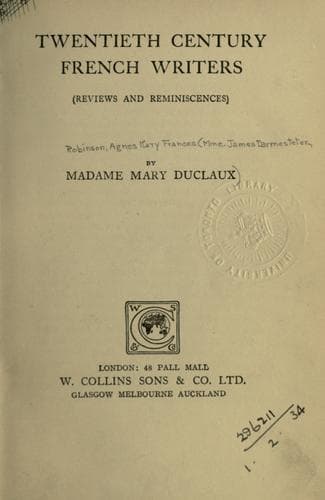
Twentieth Century French Writers: Reviews and ReminiscencesRobinson, A. Mary F. (Agnes Mary Frances)
History
Twentieth Century French Writers: Reviews and Reminiscences
Robinson, A. Mary F. (Agnes Mary Frances)
French literature -- 20th century -- History and criticism
Barrès was so weary of his own fastidious refinement that his devotion
was perhaps enhanced by the discovery that his hero was just an average
man. All that excitement and stir which his arid self-culture had
not afforded him, he expected from the perpetual agitation of public
life; he had exhausted (or thought he had exhausted, for he had not
exterminated them from his brain) the philosophers and the mystics; he
had done with Plotinus and Loyola and Hegel. Like the hero of _L’Ennemi
des Lois_, he exclaimed:--
‘Toujours les choses de l’intelligence! Je les comprends; je n’en
suis pas bouleversé. Ah! des choses qui puissent changer les âmes!’
Barrès had delved down so deep into his conception of the Ego, that
he had (so to speak) come out on the other side--at the Antipodes,
and felt the need of merging himself in something larger and more
durable than any individual existence. No longer the singular, the
extraordinary, attracted him, but the normal type. And so, in General
Boulanger, a certain pleasant vulgarity, a soldierly mediocrity of
mind, seemed charming to this subtle neophyte: he recognised the
quality--a cheap chromo-lithograph of Henri Quatre or Lafayette, and he
liked his chief none the worse for it. He saved himself from smiling
at his own enthusiasm by saying that Boulanger was just the captain to
re-conquer Alsace-Lorraine for the French.
But, all the same, Boulanger was more to the young member for Nancy
than just a glass of vermouth quaffed at the tavern door. He soon
saw that his adventurer was not adequate to the adventure; an absurd
conspiracy ended in smoke. But when the last blue volutes had curled
away, and left unchanged the face of the Republic, something important
remained deposited in the mind of Maurice Barrès: the idea of a party
which should embrace all opinions in its scheme for reform, a truly
National party, bringing out of chaos a new organic order. Then he
opened his Sophocles and pondered the magnificent line which no party
leader has ever put in practice:--
οὐτoι συνέχθειν, ἀλλα συμφιλεῖν ἐφυν.
I live to share your loves and not your hates.
And through a maze of errors (for, in my opinion, the political
adventures of Barrès were chiefly errors), this noble conception
broadened and ripened, dignifying a patriotic traditionalism with such
beauties as may spring from the hope of continuity and the sense of
order.
Public-domain text, read in full here on John Shaqi.
Reviews
Reviews
No reviews yet
Be the first to share your thoughts on this work.
Join the Discussion
Join the discussion
Sign in to leave a comment or review.
Sign InorCreate an account