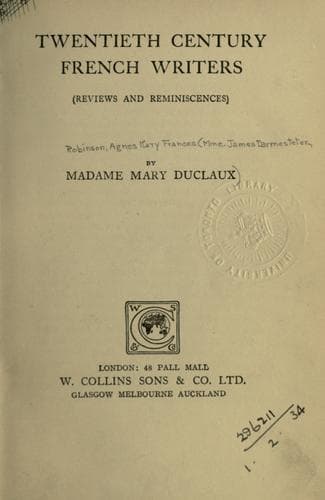
Twentieth Century French Writers: Reviews and Reminiscences — John Shaqi
Twentieth Century French Writers: Reviews and ReminiscencesRobinson, A. Mary F. (Agnes Mary Frances)
History
Twentieth Century French Writers: Reviews and Reminiscences
Robinson, A. Mary F. (Agnes Mary Frances)
French literature -- 20th century -- History and criticism
But see how differently in 1910 our traveller will read the secret of
Toledo! Now, as of old, the city on its sun-baked height, with the
tawny semicircle of the Tagus at its feet, seems less a dwelling for
men than a dreary highplace of the soul, a sanctuary set apart for
spiritual exaltation. The dry orange tone of the soil and buildings;
the town compact of convents, fortresses, and prisons; the barren
sublimity of the prospect; the violent African heat of the sky; the
vast scent of sun-dried lavender and sage and benjoin, seem proper to
some Holy City of the desert rather than to a European town. And yet in
all this sadness there is a secret pleasure.
‘J’y respire une volupté dont j’ignore le nom, et quelque chose
comme un péché se mêle à tout un passé d’amour, d’honneur et de
religion. C’est le mystère de Tolède, et nous voudrions le saisir.
Mais que donc pourrait nous guider? Toute société a fui de cette
ruine impériale.’
A painter, long dead, a foreigner--Il Greco--is the traveller’s guide.
It sometimes happens that a foreigner surprises the fine evasive spirit
of a place which escapes the native, staled by custom, until he catch
it again through the fresh acuity of a stranger’s glance. It was the
Fleming, Philippe de Champagne, newly disembarked from Brussels, who
discerned the austere heroism of Port-Royal; and a Greek from Candy
came from Venice to Toledo in his twentieth year to surprise the secret
of Spain. He painted the souls of the men and women who breathed the
same air as Saint Teresa and Cervantes.
Through him we learn the secret of Toledo, and Barrès will no longer
tell us that it is the dreary motto: _Pulvis, cinis, et Nihil_; nay,
he assures us now that it is the mystical world beyond reality--the
spiritual life. The Cretan painted the serious, narrow faces, the
bizarre, aristocratic, and elongated persons of his sitters, but
also the constant object of their secret thought: that wonderful,
mysterious, illimitable Other-World, urging and surging just on the
further side of appearances; a world to which they aspire, and ascend,
which seems to suck them up into the eddying whirlpool of the glorious
Unseen.
He loves to paint a double vision: on the lower half of his canvas Il
Greco sets the world he knows: the men of sad and sober visage, of neat
features and pointed beards and ruffs, elegant, honourable gentlemen;
scarcely, perhaps, men of a great capacity; and then above them, only
just barely overhead, a mad world (if you choose to call it mad) a
mystical world at any rate, of rushing spirits, of flooding light,
of joy and fire (_Joie! Joie! Joie! Pleurs de joie!_), a world of
adoration, bliss, eternal peace.
Public-domain text, read in full here on John Shaqi.
Reviews
Reviews
No reviews yet
Be the first to share your thoughts on this work.
Join the Discussion
Join the discussion
Sign in to leave a comment or review.
Sign InorCreate an account