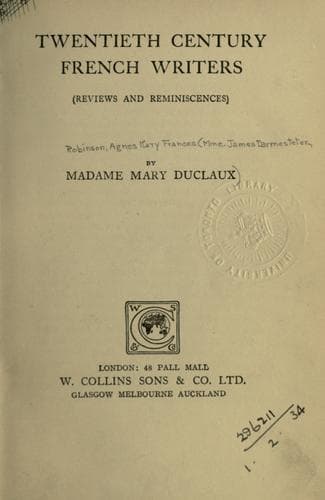
Twentieth Century French Writers: Reviews and ReminiscencesRobinson, A. Mary F. (Agnes Mary Frances)
History
Twentieth Century French Writers: Reviews and Reminiscences
Robinson, A. Mary F. (Agnes Mary Frances)
French literature -- 20th century -- History and criticism
On Herr Doktor Friedrich Asmus the land of Lorraine exercises this sort
of transformation the more readily that he adores Colette; and she is
touched by his loyalty and strength. Nature pushes her into his arms;
and old Madame Baudoche can only sigh and say, ‘C’est bien dommage
qu’il soit Allemand!’ The excellent young man sets out on his summer
holidays almost sure of Colette’s accord.
But she is a young maid of the lineage of Corneille, accustomed to
poise her feelings, and to decide less by a passion of the heart than
by a free consent of the mind. For the whole world, she would not
forfeit her sense of honour! And Asmus returns on Commemoration Day,
when all that is French in Metz is met together to attend a service in
memory of the soldiers of France fallen during the siege. During that
service something larger than herself takes possession of the heart
and soul of the little dressmaker. ‘Elle se sent chargée d’une grande
dignité, soulevée vers quelque chose de plus vaste, de plus haut et de
plus constant que sa modeste personne.’ Coming out of church she turns
to the kind and fervent young Prussian who accompanies her: ‘Monsieur
le docteur, dit la jeune fille, je ne peux vous épouser.’
Maurice Barrès also is like his heroic Colette. ‘Il se sent chargé
d’une grande dignité, soulevé vers quelque chose de plus vaste, de plus
haut, et de plus constant que sa personne.’ He has gone far since first
we met him, half-mystical, half-quizzical, rapt in the cult of the Ego.
Now, as we have said, freed from the service of Self, ‘La Terre et les
Morts’ is his watchword.
III
Or rather ‘La Terre et les Morts’ _was_ his watchword, for of late
years the Dead have revealed to him something wider and deeper than
the Land. Let us compare with the perverse charm and insidious
nihilism of his earlier book on Toledo, _Du Sang, de la Volupté et de
la Mort_ (1895), his treatment of the same theme in his recent essay
on Il Greco, and we shall catch the difference. In either volume the
landscape is the same. The scene is arid; the red, steep banks of
the ravine through which the Tagus rolls its tawny floods lead to a
city set in ruin upon its lofty rocks; no site suggests a more ardent
melancholy.
In his young days, Maurice Barrès declared that the traveller entering
Toledo tasted the same harsh and acrid pleasure that he derived from
reading Pascal’s _Pensées_ or from contemplating Michael-Angelo’s
_Penseroso_: in three gulps, it is the same rough and heroic draught.
The melancholy splendour of the scene exaggerates the stranger’s sense
of loneliness. There is an implacable indifference to his needs in
these magnificent ruins, and the yellow rocks repeat the strange device
inscribed upon a brass let into the floor of the Cathedral. Twenty
years ago, this device appeared, in the eyes of Barrès, to declare the
secret of the city. They are singular words to adorn a Christian tomb:
_Hic jacet pulvis, cinis, et nihil_.
Public-domain text, read in full here on John Shaqi.
Reviews
Reviews
No reviews yet
Be the first to share your thoughts on this work.
Join the Discussion
Join the discussion
Sign in to leave a comment or review.
Sign InorCreate an account