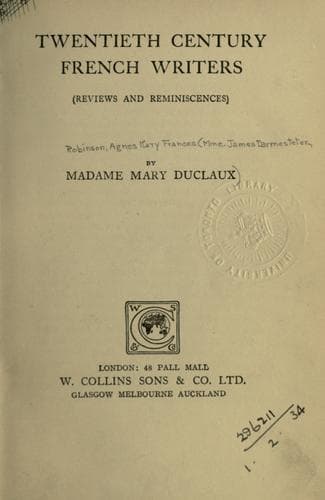
Twentieth Century French Writers: Reviews and ReminiscencesRobinson, A. Mary F. (Agnes Mary Frances)
History
Twentieth Century French Writers: Reviews and Reminiscences
Robinson, A. Mary F. (Agnes Mary Frances)
French literature -- 20th century -- History and criticism
Léopold Baillard is a real personage--almost contemporary, since
he died in 1883. He and his two brothers, born of pious peasants in
the dawn of the Nineteenth Century were three priests who dreamed of
restoring, not only in their invisible supremacy but also in their
positive and material prosperity, the prestige and the power of the
native shrines of Lorraine. They were, in fact, as we should say
(only a hundred years too soon), Celtic revivalists. Restorers of
altars fallen into decay, founders of religious congregations, they
were, during the first years of their ministry, the pride and the
miracle of Alsace as of Lorraine. The acropolis of Sainte Odile in
the Vosges and the sanctuary of Sion-Vaudémont in Lorraine became the
property of Léopold Baillard and his brothers, where they founded
convents and hostelries, and instituted an Order of Begging Sisters,
who travelled all over Europe collecting alms. (A happy touch is that
which shows Léopold Baillard in the Imperial Palace at Vienna, asking
a contribution from the Emperor of Austria as Count de Vaudémont in
Lorraine.)
Their enterprise, their intrepid imagination, their financial
audacities awakened the mistrust of a prudent bishop, who refused to
confirm the miraculous cure of one of the Sisters, and subsequently
withdrew his sanction from their quest of alms. It was the axe-stroke
at the root of the Baillards’ prosperity; it was the deliberate
quashing of a new (but a less spiritual) Port Royal. The Baillards
were obliged to sell all their possessions, and, bankrupt in purse
and credit, they were sent into retreat in a Cistercian monastery. In
that place of peace a Cistercian father inconsiderately bade Léopold
Baillard visit in Normandy a wonder-working visionary, Vintras, a
prophet in his degree.
Baillard was a sort of romantic genius--the genius of revolt and
sentiment--a man for whom the invisible world exists so naturally
that nothing in him protested when Vintras, on the occasion of their
meeting, declared himself in constant and direct communication with a
spiritual sphere. Baillard returned from Normandy to Sion-Vaudémont a
fervent disciple of the New Elias (as Vintras styled himself), and,
on the scene of his old labours, began to edify--with how much less
success!--a schismatic Church. But he is no longer the prosperous,
the genial, Abbé Léopold Baillard. His cure is taken from him, his
doctrines are condemned, his person excommunicated. He is the fallen
Angel, he whom pride misled.
Public-domain text, read in full here on John Shaqi.
Reviews
Reviews
No reviews yet
Be the first to share your thoughts on this work.
Join the Discussion
Join the discussion
Sign in to leave a comment or review.
Sign InorCreate an account