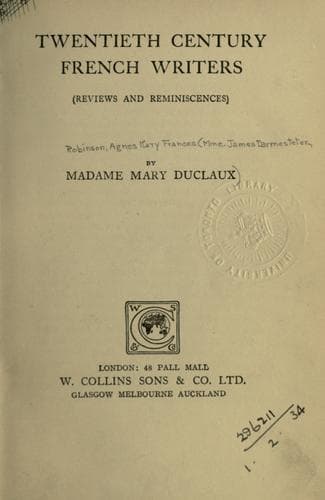
Twentieth Century French Writers: Reviews and ReminiscencesRobinson, A. Mary F. (Agnes Mary Frances)
History
Twentieth Century French Writers: Reviews and Reminiscences
Robinson, A. Mary F. (Agnes Mary Frances)
French literature -- 20th century -- History and criticism
There is tenderness as well as irony, poetry as well as tragedy, deep
compassion mixed with a half-reluctant disapproval in the eloquence
of M. Barrès, as he relates the downfall of the schismatic--his
follies, his errors, his sufferings, his long martyrdom, his final
reconciliation with the Church. _Melius est ut pereat unus quam
unitas._ Yet if that one be Pascal, or Fénelon, or Father Tyrrell,
or even an Abbé Léopold Baillard (so mere a peasant in his harsh
materialism, so nearly a saint in his inspired spirituality), how shall
one not admire the ardour, the grandeur, the genius, the generosity
of a soul superior to the docile flock? The lost sheep (depend upon
it) was the fairest of the fold--and was, as we know, the dearest to
the immortal Shepherd. The sympathies, if not the convictions, of the
author are evidently with the vanquished prophet. For a religion, says
our author, is made of two elements, with difficulty conciliable, yet
equally vital: on the one hand, enthusiasm, inspiration; on the other,
discipline, authority.
‘Eternel dialogue de ces deux puissances! À laquelle obéir? Et
faut-il donc choisir entre elles? Ah! plutôt qu’elles puissent,
ces deux forces antagonistes, s’éprouver éternellement, ne jamais
se vaincre et s’amplifier par leur lutte même. Elles ne sauraient
se passer l’une de l’autre. Qu’est-ce qu’un enthousiasme qui
demeure une fantaisie individuelle? Qu’est-ce qu’un ordre qu’aucun
enthousiasme ne vient plus animer?’
_Est aliquid hominis quod nec ipse scit spiritus hominis qui in ipso
est_: there is more in man than the soul of man conceives. This line of
Saint Augustine (which serves as an epigraph to _La Colline Inspirée_)
might be inscribed above all Maurice Barrès’ later writings: they are
all laid on the altar of an Unknown God. Nothing in the eyes of this
barely orthodox critic is more sacred, more moving than a village
church, whose narrow chancel has echoed the prayers, the praise, of
countless spirits straining to approach the secret Reality which
sustains the world of Appearances. The stones have witnessed the tears
of generations many times renewed as they consigned their dead to
the keeping of God; before the same altar fathers and children have
plighted their troth; and the font served to christen the grandsires
of to-day. A village church is, to an imaginative mind, a thing which
revives the sacred memory of our country and our dead. And so--not in a
spirit of narrow orthodoxy--but in the largest and most human movement
of generosity--Barrès takes up his pen to plead for the churches of
France, falling into ruin since the separation of Church and State.
Public-domain text, read in full here on John Shaqi.
Reviews
Reviews
No reviews yet
Be the first to share your thoughts on this work.
Join the Discussion
Join the discussion
Sign in to leave a comment or review.
Sign InorCreate an account